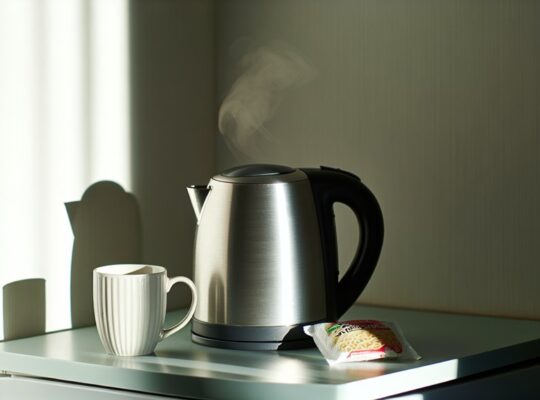
You’ll want a kettle that’s quiet, compact, and safe so it won’t disrupt calls or hog desk space. Pick models with auto shut-off, boil-dry protection, and a cool-touch exterior, plus precise temps if you brew specialty tea or pour-over coffee. I’ll point out top picks, space-saving layouts, and simple maintenance tips that keep your setup tidy and reliable — useful whether you share a kitchen or keep everything at your desk.
Key Takeaways
- Choose a low-wattage, compact kettle with auto shut-off and boil-dry protection to protect office circuits and prevent hazards.
- Prefer double-wall or insulated designs and silicone feet to reduce vibration and steam noise at shared desks.
- Select precise temperature controls (presets and hold function) for tea, coffee, and baby formula accuracy.
- Use a narrow gooseneck spout for controlled pouring and a clear water-level indicator to avoid spills.
- Place kettle on a heat-resistant mat near a grounded outlet, manage the cord, and descale regularly for safety and quiet performance.
Why Choose a Quiet, Compact Electric Kettle for Workspaces
Why pick a quiet, compact electric kettle for your workspace? You’ll get fast, controlled boiling without disruptive noise that breaks focus or interrupts calls. A compact unit fits small desks and shared kitchens, so you won’t need extra counter space or awkward storage. You’ll appreciate models with clear safety features—auto shut-off, boil-dry protection, and cool-touch handles—to reduce burn and fire risks during busy days.
Choosing a low-wattage, efficient kettle also protects office circuits and lowers energy use, which matters in shared environments. Look for stable bases and limescale-resistant materials to prevent leaks and maintain water quality. A quieter element and insulated body cut steam and sound, keeping the area comfortable for colleagues. You’ll want a straightforward design that’s easy to clean and maintain; complicated parts increase misuse and hazards. Overall, a quiet, compact kettle gives you reliable hot water while prioritizing safety, convenience, and minimal disruption in professional settings. Electric kettles with automatic shut-off help prevent overheating and are especially useful in busy offices.
Top Quiet Electric Kettle Models for Offices and Home Offices
Now that you know what features matter—quiet operation, compact size, safety cutoffs and low wattage—let’s look at specific models that deliver on those priorities. You’ll want kettles that minimize noise, include reliable auto-shutoff and boil-dry protection, and won’t overload office circuits. Below are four recommended picks, with a brief evaluative note on each so you can match features to your workspace needs.
- Fellow Stagg EKG (or quieter variant) — precise temperature control, dependable safety sensors, premium build.
- Cosori 1.7L Stainless — modest noise, multiple temp presets, clear safety cutoffs, value-focused.
- Hamilton Beach 1.0L (compact model) — low wattage option, compact footprint, straightforward safety features.
- Breville One-Touch Mini — rapid heating with insulated handle, safety interlocks, quieter element design.
Choose based on capacity needs, cordless convenience, and verified safety certifications for peace of mind in shared workspaces. Be mindful of train and venue rules and safety concerns when using personal appliances, especially regarding automatic shut-off and circuit overload risks.
Space-Saving Designs and Compact Form Factors
You’ll want a kettle that fits your workspace without dominating it, so look for slim-footprint models that tuck neatly on narrow countertops or shelves. Consider collapsible or folding kettles if you need something ultra-portable for hot-desking or small shared offices. Compare build quality, boiling speed, and stability to ensure a compact design doesn’t sacrifice safety or performance. Many travelers also value kettles that work from a 12-volt supply so they can be used in cars during long journeys.
Slim Footprint Models
If space is at a premium, pick a slim-footprint kettle that tucks into tight counters and shared office corners without sacrificing core performance. You’ll want models with narrow bases and vertical profiles that keep capacity reasonable while freeing bench space. Prioritize stable, low-center designs and cool-touch exteriors to reduce tipping and burn risk. Look for accessible limescale filters and straightforward controls for quick, safe use.
- Narrow base with tall body — maximizes volume, minimizes counter area.
- Single-button or dial controls — reduces mistakes during busy shifts.
- Auto-shutoff and boil-dry protection — essential safety features.
- Detachable base with cord storage — keeps shared areas tidy and safe.
Collapsible or Folding Kettles
When counter space is extremely limited, consider a collapsible or folding kettle that packs down for storage between uses—these models give you full boiling performance without a permanent footprint. You’ll like how they collapse to a few inches for drawers or cabinets, freeing up work surfaces. Look for BPA-free silicone bodies, reinforced rims, and locking lids to reduce spill and steam risk. Check wattage — higher watts boil faster but may need a dedicated outlet; lower wattage is gentler on office circuits. Prefer models with automatic shutoff, boil-dry protection, and cool-touch handles. Test stability when expanded; flimsy designs increase tipping hazards. Overall, a well-built collapsible kettle blends safety, portability, and compactness for tight office or WFH spaces.
Safety Features to Look For: Auto Shut-Off and Boil-Dry Protection
Wondering which safety features matter most in an office or WFH kettle? You want reliable protections that reduce risk without extra fuss. Two basics are auto shut-off and boil-dry protection — they prevent overheating and fires if the kettle’s empty or left unattended. Look for tested, certified components and clear indicators so you can trust the kettle during busy workdays.
- Certified auto shut-off — cuts power when water reaches a boil; avoids runaway heating.
- Boil-dry protection — senses low or no water and disables heating to prevent element damage.
- Visual/audio indicators — clear LEDs or a subtle beep confirm the safety features activated.
- Durable switch and housing — quality build reduces failure risk over time and frequent use.
Prioritize models with third-party safety certifications (CE, UL, ETL) and straightforward user manuals. You’re buying peace of mind: pick a kettle that makes safety obvious and dependable. Also consider compatibility with your travel or shared-power settings, especially when using appliances in transit or communal spaces like trains where power outlets and safety rules vary.
Temperature Control and Pouring Precision for Beverages
You’ll want a kettle that gives precise temperature settings so you can brew coffee and tea at the exact heat each recipe calls for. A variable hold function is handy for keeping that temperature ready without reheating, saving time during busy workdays. Also look for a controlled pour spout — it makes delicate pouring, like for pour-over coffee, consistent and spill-free. Regular descaling helps maintain efficiency and safety for long-term use, so consider models with easy-to-clean elements and descaling instructions.
Precise Temperature Settings
How precise does your kettle need to be? You want reliable temps for tea, coffee, baby formula and safety. Pick kettles with clear temperature presets and +/-1–2°C accuracy so you avoid scalding or under‑extraction.
- Choose preset steps (e.g., 60/70/80/90/100°C) for repeatable results.
- Look for digital displays and accurate probes — they cut guesswork and risks.
- Prefer models with automatic shutoff and boil‑dry protection tied to temp control.
- Consider variable temperature control if you brew specialty teas or need exact hot water for formula.
You’ll pay more for precision, but it reduces waste, improves flavor consistency and enhances safety. Test accuracy with a thermometer before daily use.
Variable Hold Function
Why settle for a single boil when you can keep your water at the exact temperature you need? A variable hold function maintains chosen temps for set periods, so you won’t reheat and risk scalding or mineral buildup. You’ll want a model that reports hold time and temp accurately, with automatic shutoff and clear indicators so you’re never guessing. For tea, coffee, or baby formula, holding at the target temp preserves flavor and safety without wasting energy. Evaluate battery-style displays, insulated housings, and easy-to-use controls that prevent accidental changes. Prioritize kettles with reliable thermostats and safety certifications; they reduce overheats and pressure issues. The right hold feature gives precision, convenience, and peace of mind.
Controlled Pour Spout
Looking for precise pours that don’t splash or overheat your brew? You want a controlled pour spout that gives temperature accuracy and drip-free flow, so you avoid scalds and wasted beverage. Evaluate spout shape, flow rate, and lid fit for predictable pours.
- Narrow gooseneck spout — steady, slow stream for teas and pour-over coffee.
- Wide precision spout — faster pour without splashing, good for mugs and instant drinks.
- Splash guard and tight lid — prevents hot droplets and reduces steam escape.
- Clear water-level markings near spout — lets you measure and avoid overfilling.
Choose kettles with consistent temperature hold and ergonomic handles so you can pour safely, confidently, and repeatably at the right heat.
Noise-Reducing Materials and Operational Tips
Usually, you’ll notice that noise from an electric kettle comes from vibration, steam release, and contact with hard surfaces, so choosing models with insulated housings, silicone feet, and low-vibration heating elements cuts sound at the source. Look for double-wall or foam-lined exteriors; they damp vibration and keep surfaces cooler so you can handle the kettle safely after use. Silicone or rubberized bases absorb impact and stop rattling on desks.
Operational tips boost quiet performance: fill to required volume instead of boiling more water, use lower temperature presets when possible, and lift the lid carefully to reduce sudden steam bursts. Descale regularly — limescale increases buzzy noises and reduces efficiency. Choose kettles with gentle auto-shutoff and cool-touch handles to prioritize safety while minimizing abrupt sounds. Test models in-store or read measurements in dB when available; a small reduction in decibels makes a noticeable difference in shared or WFH environments. Electric kettles heat water quickly because a built-in heating element converts electrical energy into heat.
Placement, Power Access and Cord Management on Small Desks
Noise control matters, but where you place the kettle and manage its power can be just as important on a small desk. You’ll want a spot that keeps heat, steam and cord clutter away from papers and electronics while staying within reach.
- Position the kettle on a heat-resistant pad at least 6–8 inches from monitors and paperwork to protect surfaces and reduce steam exposure.
- Use a nearby outlet or a short, grounded extension with built-in surge protection; avoid stretching cords across your workspace where they can snag.
- Route the cord along the desk edge and secure it with clips or adhesive channels so it won’t pull the kettle or create tripping hazards when you move.
- Keep water-filling and pouring access clear; place the kettle where you can refill safely without lifting over cables or devices.
Evaluate placement for safety first, then convenience. If space forces compromises, prioritize stable footing and easy unplugging to prevent spills and electrical risks. Glass kettles made from borosilicate glass resist scratches and thermal shock, making them a safer, longer-lasting choice for frequent office use.
Useful Accessories and Maintenance for Office Use
Want your desk kettle to stay reliable and low-fuss? Choose a small drip tray or heat-resistant mat to protect surfaces and catch spills — they’re inexpensive and cut cleaning time. Use a compact gooseneck or pour-over kettle if precision matters; their narrower spouts reduce splashing and make brewing safer. Keep a dedicated, labeled mug and insulated cup to avoid cross-contamination and minimize trips to the sink.
Descale regularly with a mild citric-acid solution or vinegar per the manufacturer’s schedule; write the next descaling date on a sticker so you don’t forget. Keep a soft brush for the spout and base edge; never immerse cordless bases. Store a small first-aid burn pack and a silicone trivet nearby if you share space; both are low-cost safety upgrades. Finally, keep the kettle’s manual and warranty in a desk folder or scan — that makes troubleshooting, parts replacement, and safe operation straightforward. Consider choosing a stainless-steel model for durability and safety, as many top-rated kettles feature a stainless steel body.
How do you pick an office kettle that fits your space and users? Start by assessing capacity, noise, safety features and footprint so you get a model that suits whether it’s a shared kitchen or a private desk.
- Capacity and flow: Match liters to user load — 0.8–1.7 L for small teams, single-cup for solo desks. Faster boil reduces wait times.
- Noise and speed: Choose lower-decibel models with rapid heating if colleagues dislike noise; look for insulated or flat-base elements.
- Safety and controls: Prioritize auto shut-off, boil-dry protection, cool-touch exteriors and secure lids to prevent spills in busy areas.
- Size, cord and cleaning: Pick compact footprints, cordless bases or retractable cords for tidy counters and removeable limescale filters for hygiene.
You’ll want reliable brands with clear warranties and straightforward user manuals. In shared settings, favor robust stainless interiors and simple controls; for private use, compact, quieter options boost convenience without compromising safety. Consider a 2-litre stainless steel option like the iBELL SEK20BM for larger teams and quick boiling when serving multiple people.
Frequently Asked Questions
Can a Kettle Be Used Safely Near Computer Equipment?
Yes—you can, but you shouldn’t place a kettle too close. You’ll want spill-resistant placement, splash guards, and at least a few feet from computers. Choose compact, auto-shutoff models and keep cords away from equipment.
Do Compact Kettles Work With International Voltages?
Some compact kettles do support international voltages, but many don’t; you’ll need a dual-voltage model or a suitable converter, check wattage, plug type, and safety certifications to ensure safe, reliable use abroad.
Are There Noise Regulations for Office Appliances?
There aren’t universal noise regulations for office appliances, but local workplace health and building codes or company policies may set limits; you’ll want quiet-rated models, decibel data, and compliance with occupational noise and disturbance guidelines to stay safe.
Can I Use Filtered Water Cartridges Inside Kettles?
You generally can’t use standard filtered water cartridges inside kettles because they’re not designed for boiling, may release fibers or plastics, and can clog elements; use pre-filtered water or kettles with built-in certified filtration for safety and longevity.
How Quickly Do Small Kettles Boil Compared to Full-Size Models?
Small kettles boil noticeably faster—often 3–5 minutes for 1 liter or less—while full-size models take 6–10 minutes for 1.7–2 liters. You’ll trade capacity for speed; choose based on safe, practical needs.