If you’re choosing between a 1500W and a 1000W kettle, wattage mainly affects how fast water heats and how much current the appliance draws. A 1500W model will boil quicker and handle larger volumes, while a 1000W unit is gentler on older circuits and can be more consistent for small fills. The best pick depends on your wiring, how much water you boil, and whether speed or electrical margin matters more to you.
Key Takeaways
- 1500W boils water about 50% faster than 1000W, reducing time from roughly 6 to 4 minutes per liter.
- Energy per boil is nearly the same for both; higher power just shortens the heating time.
- 1500W draws more current, increasing circuit load and risk of tripping on limited wiring or shared outlets.
- 1000W offers gentler thermal ramping, quieter operation, and potentially longer component life.
- Choose 1500W for speed and larger volumes, or 1000W for safer margins on weak circuits and small servings.
How Wattage Affects Boil Time
Wondering why a 1500W kettle boils faster than a 1000W one? You’ll see it’s basic power-to-energy delivery. Wattage is the rate electric energy is converted to heat; higher watts supply more joules per second to the heating element. For a fixed water mass and temperature rise, the required energy is constant (Q = m·c·ΔT). A 1500W unit reaches that energy threshold sooner because it delivers roughly 50% more power than a 1000W model, shortening time proportionally, neglecting minor losses.
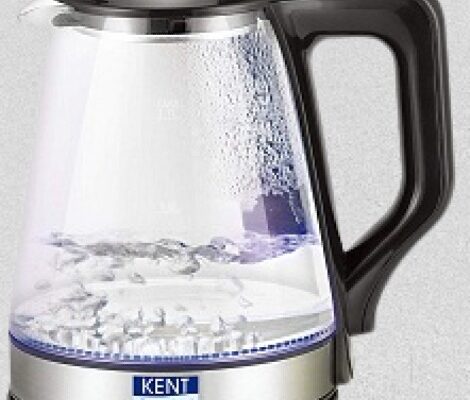
In practice, heat losses to the kettle body and surroundings and element efficiency slightly reduce the ideal ratio, so boil time improvement is close but not exactly proportional. You should factor in safety: faster heating increases risk of scalding if unattended, so use automatic shutoff, boil-dry protection, and stable placement. For controlled, safe operation, match wattage to intended volume and follow manufacturer safety features. Glass kettles are corrosion-resistant and allow easy monitoring of water levels, which can help with safe operation.
Energy Consumption: 1500W Vs 1000W
You’ll see that a 1500W kettle draws 50% more power than a 1000W unit, which shortens heating time proportionally. Compare the faster heat-up against the instantaneous power spike to calculate energy per boil (kWh = power × time). That comparison shows whether the higher wattage actually uses more energy per boil or simply delivers the same energy faster. Room temperature eggs and egg size affect cooking time when using kettles for boiling.
Power Draw Comparison
How much more energy does a 1500W kettle pull compared with a 1000W model? You’ll see a 1500W unit draws 50% more power at any instant: 1.5 kW versus 1.0 kW. On mains rated in amperes, a 1500W kettle at 230V draws ~6.5 A, while a 1000W draws ~4.3 A; at 120V those are ~12.5 A and ~8.3 A respectively. That higher current affects circuit loading, fuse selection, and cable heating—important for safe installation and simultaneous appliance use. Peak draw matters for household wiring and RCD/trip sensitivity; repeated high-current cycles increase thermal stress on switches and connectors. When choosing, match kettle rating to circuit capacity and protective device specifications to reduce overheating and tripping risks.
Heating Time Differences
How much faster does a 1500W kettle heat the same volume of water compared with a 1000W model? You’ll see roughly a 33% reduction in time because power scales linearly for the same thermal load; 1500W supplies 1.5× the heating power of 1000W. That means if a 1000W kettle brings 1 L from 20°C to 100°C in about 6 minutes, a 1500W unit does it in roughly 4 minutes, ignoring minor losses. Faster heating reduces time exposed to hot surfaces and steam, but increases instantaneous electrical demand; ensure your circuit and kettle controls are rated accordingly. Consider boil-dry protection and secure lid design when choosing higher-power units.
- Typical time scaling: inverse of power
- Thermal losses slightly reduce ideal gain
- Faster boil = less steam exposure
- Confirm safety features and circuit capacity
Energy Used per Boil
Curious about whether the 1500W kettle actually uses more energy per boil than the 1000W? You’ll find that energy (in joules or kWh) equals power multiplied by time. A 1500W unit finishes faster, so its higher power is offset by shorter run duration. For a given water mass and identical heat losses, energy per boil is nearly the same: E = m·c·ΔT plus losses. Practically, the 1500W kettle might use slightly more or less depending on insulation and element efficiency. If safety’s a concern, shorter boil time reduces exposure to live components and steam; better-insulated models limit wasted energy and surface heat. Choose the kettle with proven thermal efficiency and safety certifications to minimize consumption and risk.
Practical Differences in Everyday Use
You’ll notice the 1500W model cuts boil time substantially compared with the 1000W, which matters when you need hot water fast. That speed can reduce runtime energy but may shift peak power draw, so you’ll want to weigh total kWh per use against your circuit limits. Also compare audible operation and build quality—faster heating can mean louder elements and different wear patterns affecting longevity. The AGARO Galaxy offers features like a 24-hour Keep Warm function that can influence real-world convenience and energy use.
Boil Time Differences
Wondering whether the extra 500W matters in daily use? You’ll notice measurable boil time differences: a 1500W kettle brings a given water mass to 100°C faster than a 1000W unit, roughly proportional to power assuming similar efficiency and heating element placement. That reduces waiting time and exposure to repeated handling.
- 1500W typically reduces boil time by about one-third for the same volume, useful when you’re time-sensitive.
- For small volumes (under 300 ml) the difference shrinks due to surface losses and thermostat cycling.
- Faster boil means less time the kettle and cord are hot, lowering some handling risks if you’re cautious.
- Ensure both kettles meet safety cutoffs; quicker boils don’t replace correct use and placement.
Energy Consumption Tradeoffs
How much extra electricity will that 1500W kettle actually use compared with a 1000W one in everyday use? You’ll use more instantaneous power with the 1500W unit, but total energy depends on boil duration. If a 1000W kettle takes 6 minutes and a 1500W takes 4 minutes to boil the same volume, energy (kW·h) is power × time: 1.0 kW × 0.1 h = 0.1 kWh versus 1.5 kW × 0.0667 h ≈ 0.1 kWh — nearly identical. Small differences arise from heat losses and start/stop inefficiencies; faster boils reduce convection losses but may increase element cycling. In practical use you won’t see large electricity differences per boil; focus on volume boiled and insulation to control consumption safely.
Noise and Longevity
After energy use, two practical factors that often sway your choice are noise and longevity. You’ll notice 1500W kettles boil faster, which can increase mechanical wear and produce sharper valve and element noise; 1000W models run cooler, yielding gentler acoustics and slightly reduced stress on components. Predictable maintenance and safe operation depend on build quality more than wattage, but duty cycles differ.
- 1500W: faster boil, higher cycle frequency, potential for earlier component fatigue.
- 1000W: slower thermal cycling, typically quieter operation, reduced stress.
- Safety note: frequent dry-boil protection and thermal cutouts extend lifespan regardless of wattage.
- Inspection tip: check seals, element exposure, and noise sources annually to prevent hazards and maintain quiet performance.
Kettle Design and Heat Transfer Efficiency
Why does kettle geometry matter as much as wattage? You’ll see that shape, element position, and material thickness control how efficiently electrical power becomes boiling water. A wider base increases contact area with a concealed heating plate, shortening time-to-boil for a given wattage; a narrow, tall vessel concentrates convection but reduces surface conduction. Open coil versus flat-plate elements change localized heat flux and scaling risk—flat plates spread heat evenly, lowering hotspot formation and improving safety. Thermal conductivity of stainless steel, aluminum, or copper liners governs heat transfer rates; thin walls heat faster but can warp or transfer heat to handles if poorly insulated. Lid fit and spout design alter evaporation losses and steam pathing, affecting perceived efficiency and burn risk. You’ll balance geometry against wattage: a well-designed 1000W kettle can outperform a poorly designed 1500W model in practical efficiency while maintaining safer, more predictable thermal behavior. Electric kettles also offer automatic shut-off and portability that add practical convenience beyond raw power.
Typical Household Electrical Limitations
You’ll need to check your circuit breaker ratings because a 1500W kettle draws about 12.5 A on a 120V supply, which approaches the limit of a typical 15 A circuit. Compare that to a 1000W kettle at ~8.3 A to see how much headroom remains on the same outlet amperage limit. If multiple high-draw appliances share the circuit, you risk nuisance tripping or overheating wiring. Regular descaling and maintenance can help maintain kettle efficiency and reduce long-term stress on the electrical system.
Circuit Breaker Ratings
Most household circuits are rated 15–20 amps, which limits the safe continuous draw you can put on a single outlet; at 120 V that means roughly 1800–2400 watts available before you risk tripping the breaker. You’ll compare kettle power to that ceiling: a 1500W kettle consumes most of a 15A circuit’s safe continuous allowance, while a 1000W kettle leaves more headroom for other loads. That matters when multiple devices share a circuit or when continuous duty heating reduces breaker margin.
- 1500W uses ~12.5A, close to continuous limits on a 15A circuit.
- 1000W uses ~8.3A, giving safer margin for other devices.
- Multiple high-power appliances can cause nuisance trips.
- Breaker sizing protects wiring from overheating; don’t exceed ratings.
Outlet Amperage Limits
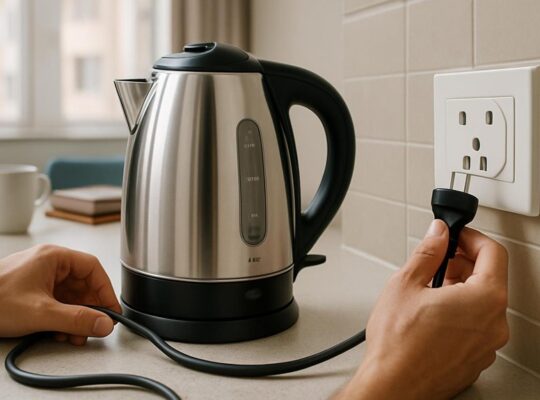
Circuit breaker ratings set the overall limit, but outlet receptacles themselves have specific amperage limits you should consider when choosing between a 1500W and 1000W kettle. Typical North American outlets are rated 15A or 20A; a 1500W kettle at 120V draws about 12.5A, a 1000W draws ~8.3A. That means a single 15A outlet can handle either kettle individually, but a 1500W device leaves less headroom for concurrent loads on the same circuit. If the outlet shares a circuit with other appliances, the aggregate current can exceed the breaker trip threshold. You should verify outlet rating, avoid extension cords or multi-plug adapters that may be underrated, and prefer dedicated circuits for high-power kettles to minimize overload and fire risk.
Safety Features and Overload Risks
How does wattage affect safety when you’re choosing between a 1500W and a 1000W kettle? Higher wattage raises instantaneous current draw, so a 1500W unit stresses wiring and protective devices more than a 1000W one. You’ll want kettles with robust safety features to mitigate overload and thermal risk; features can compensate for higher draw but don’t change the physics of current and heat.
- Automatic shut-off: cuts power at boil or on open-lid detection, reducing sustained heating and overload probability.
- Boil-dry protection: detects no-water conditions to prevent element overheating and fire risk.
- Thermal fuses and cutouts: provide fail-safe disconnection if temperatures exceed safe limits.
- Current and cable ratings: appropriate cord gauge, plug and internal wiring reduce resistive heating and voltage drop under higher amps.
Choose units whose protective components exceed expected stress for your circuit; that minimizes overload incidents while preserving performance. Many kettles also include automatic shut-off and boil-dry features to enhance safe, convenient use.
Cost Considerations: Purchase and Running Costs
Want faster boils or lower bills? You’ll weigh purchase price, run-costs and safety features when choosing 1500W vs 1000W. A higher-watt kettle costs a bit more upfront but cuts boil time; that reduces electricity consumed per boil marginally and lowers cumulative run-costs if you boil frequently. Lower-watt units cost less to buy, draw less current (safer on weak wiring) and suit low-use households.
| Metric | 1500W kettle | 1000W kettle |
|---|---|---|
| Typical purchase price | Higher | Lower |
| Current draw | ~6.5A (230V) / ~12.5A (120V) | ~4.3A (230V) / ~8.3A (120V) |
| Boil time (1L) | Shorter | Longer |
| Energy per boil | Slightly higher or similar | Slightly lower or similar |
| Suitability | High-use, robust wiring | Low-use, limited circuits |
Compare cost-per-boil and local electricity rate; also confirm kettle safety certifications and automatic shutoff to minimize risk. A 1500W kettle with automatic shut-off and boil-dry protection can improve safety and reduce wasted energy.
Environmental Impact and Energy Waste
Beyond purchase and running costs, you should also consider the environmental footprint and where energy gets wasted between 1500W and 1000W kettles. Faster heating reduces standby losses per boil but can increase peak grid demand; slower units run longer and may lose more heat to the environment during operation. You’ll want to weigh total energy per boil, not just power rating.
- Faster boil: higher instantaneous draw, slightly more embodied emissions if heavier components needed.
- Longer boil: increased conductive and convective heat loss from the kettle body and lid.
- Cycling and overboil: poor controls waste energy; look for precise cut-off and dry-boil protection.
- Grid mix sensitivity: on a fossil-heavy grid, faster kettles may raise marginal emissions during peak times; on low-carbon grids, differences are smaller.
Choose efficient insulation, reliable thermostats, and safety features to minimize both energy waste and risk. Electric kettles also serve many other quick-heating household tasks, such as making instant noodles and brewing French press coffee, which can influence how often you boil and therefore affect lifetime energy use.
Choosing Based on Water Volume and Frequency
Considering the amount of water you heat each time and how often you boil it will determine whether a 1500W or 1000W kettle is more practical: higher-power kettles cut boil time, so they’re better when you regularly heat large volumes or need rapid turnaround, while lower-power models suffice if you mostly boil small quantities infrequently. If you routinely fill to capacity (1.5–2.0 L), a 1500W unit reduces time-to-boil significantly, lowering exposure to prolonged heating and reducing risk of accidental dry-boil events. For repeated back-to-back cycles—office use or multiple servings—the faster recovery of a higher wattage improves throughput and operational safety by minimizing unattended heating. Conversely, if you heat 250–500 ml intermittently, the absolute energy difference per boil is small and longer boil time poses limited additional hazard. Evaluate duty cycle, average fill volume, and how often you leave the appliance unattended; prioritize a model with reliable automatic shutoff and thermal cutout regardless of wattage. Also consider choosing a travel-safe certified kettle with automatic shut-off and overheat protection to reduce fire and overload risks.
When a Lower Wattage Kettle Makes More Sense
When does a lower-wattage kettle actually make more sense? You’ll prefer a 1000W model when your priorities are controlled heating, electrical limitations, and safety. It heats slower but offers predictable thermal ramping, reducing boil-over risk and stress on wiring. Compared to 1500W, it draws less current, lowers trip risk for older circuits, and gives you finer control when you only need small amounts.
- Safer on weak wiring: lower amperage reduces overload and fire risk.
- Better for small volumes: gentler heat avoids rapid evaporation and splashing.
- Energy management: less peak load helps in homes with solar inverters or limited supply.
- Durable operation: reduced thermal cycling can extend element and thermostat life.
Choose 1000W when safety, circuit constraints, and precise heating for small servings matter more than speed. The 1000W option is often ideal for settings where a larger-capacity appliance like a 1.5 litre electric glass kettle is used to serve multiple people while maintaining safety and hygiene.
Frequently Asked Questions
Can a 1500W Kettle Damage My Countertop Surface?
Yes — a 1500W kettle can damage surfaces if you place it on heat-sensitive materials; it concentrates heat faster than lower-wattage models. Use insulating pads, heat-resistant mats, or cool-touch bases to prevent burns or discoloration.
Do Higher-Wattage Kettles Need Special Warranties?
No, higher-wattage kettles don’t inherently need special warranties; you’ll want manufacturers to cover electrical, thermal, and surge-related failures, so compare warranty scope, duration, and exclusion clauses before assuming standard coverage suffices.
Are Replacement Parts Easier to Find for 1000W Models?
Yes — you’ll generally find replacement parts for 1000W kettles easier: they’re more common, simpler, and use lower-stress components. You’ll still check model compatibility, safety certifications, and genuine parts to ensure reliable, safe repairs.
No, a 1500W kettle typically won’t raise your home insurance premiums by itself, but insurers care about fire risk and usage patterns, so higher-power appliances used safely and with proper maintenance and certified plugs shouldn’t affect rates.
Do Wattage Differences Affect Tea or Coffee Taste?
Yes — wattage can affect extraction speed and temperature stability, so a higher‑wattage kettle heats faster and holds temperature better, which can yield more consistent tea or coffee flavor; you should monitor safe handling and boil control.