If you want to know how much electricity your kettle uses, start with its wattage and how long it runs — most kettles are 1,200–3,000 W and boil a liter in 3–10 minutes. Multiply kW by hours for kWh, then apply your tariff to get cost. Real-world efficiency is ~80–90%, so practical energy is slightly higher than the ideal. Keep going to see quick formulas, examples, and simple ways to cut use.
Key Takeaways
- Typical kettles draw 1,200–3,000 W; higher wattage boils faster but uses similar energy per liter.
- Energy per boil (kWh) = Power (kW) × Time (h); e.g., 2.2 kW × 4 min (0.0667 h) ≈ 0.147 kWh.
- Electric kettles convert about 80–90% of input energy into heating the water; losses raise required energy slightly.
- Boiling 1 L from 20°C to 100°C typically uses ~0.10–0.15 kWh, depending on kettle efficiency and heat losses.
- Cost per boil = energy (kWh) × your electricity rate ($/kWh); multiply by daily usage for monthly/yearly cost.
How an Electric Kettle Converts Electricity Into Heat
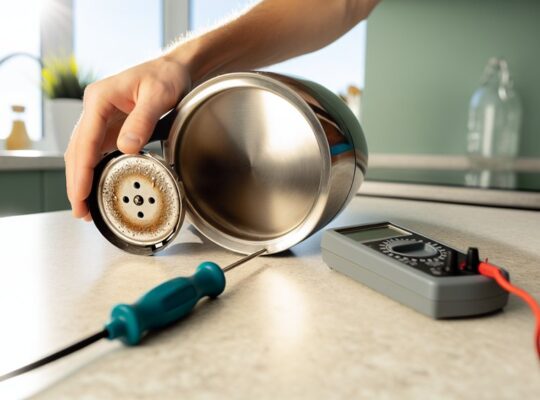
An electric kettle converts electrical energy into heat primarily through Joule heating: when current passes through its resistive heating element, the element’s electrical resistance dissipates energy as thermal energy, which then raises the water temperature. You’ll find the heating element (exposed or concealed) has a measured resistance that determines current draw at mains voltage; power (P = V^2 / R) sets the rate of energy transfer. Heat flows from the element into the water via conduction and convection; greater surface contact and turbulence improve transfer efficiency. Insulation and lid fit reduce convective and radiative losses, so more input power goes into warming water rather than escaping. Thermostatic cutouts or boil-dry protection interrupt current when the set temperature or absence of liquid is detected, preventing overheating and reducing fire risk. For safe, efficient operation, ensure good contact between element and vessel, keep seals intact, and replace units with failed safety switches rather than bypassing protections. On trains and other public transport, however, use of personal electric kettles may be restricted due to fire hazard and electrical safety concerns.
Typical Power Ratings and What They Mean
Most household kettles are rated between about 1,200 and 3,000 watts, so you’ll see substantial differences in boil speed. Higher wattage means faster heating but also higher instantaneous power draw, which raises energy use per minute of operation. To compare real cost, look at watts and expected boil time—energy (kWh) = watts × hours—so you can choose the best balance of speed and efficiency. The Wipro Vesta, for example, runs at 1500 Watts and offers efficient boiling for larger households.
Typical Wattage Range
Curious how much power your kettle actually draws? Typical household kettles run between 1,200 W and 3,000 W; knowing that range helps you pick a safe, efficient unit.
- 1,200–1,500 W: lower-power models boil slower, draw less current—good if your wiring is older or shared.
- 1,800 W: common mid-range balance of speed and manageable circuit load for most kitchens.
- 2,200–2,400 W: faster boiling, requires a dedicated outlet or cautious simultaneous appliance use to avoid tripping breakers.
- 2,800–3,000 W: high-power commercial-style kettles; very fast but demand high current and stronger wiring.
Check your kettle’s rating plate and ensure your outlet and breaker match the wattage for safe operation.
Effect on Energy Use
Knowing the wattage range helps you predict how much energy a kettle will actually use: power (watts) tells you rate of energy use, while time boiling gives total energy consumed (watt-hours or kilowatt-hours). If your kettle is 1500 W and it boils in 3 minutes, energy = 1.5 kW × 0.05 h = 0.075 kWh. A 3000 W model that halves boil time to 1.5 minutes uses the same energy, roughly, but inefficiencies and heat loss can change that by 5–15%. For routine savings, use the right capacity for the job, keep the element descale-free, and avoid overfilling. For safety, unplug when not in use and follow manufacturer max-fill and maintenance guidelines to maintain efficiency and reduce fire risk.
How Long Does It Take to Boil a Liter of Water?
Wondering how long it takes to boil a liter of water in an electric kettle? Typical kettles (1,500–3,000 W) bring 1 L from 20°C to 100°C in about 3–5 minutes. Actual time depends on kettle power, initial water temperature, and heat losses. You can control variables to be faster and safer.
- Use higher wattage: a 3,000 W kettle reaches boiling roughly twice as fast as a 1,500 W model, all else equal.
- Start with warmer water: room-temperature or preheated water cuts minutes off the boil time.
- Minimize heat loss: keep the lid closed and avoid pouring unused water into a cold cup; less heat escape equals faster boil.
- Follow safety steps: don’t overfill, ensure dry base and intact cord, and unplug after boiling to prevent overheating or scald risk.
Electric kettles use a heating element to convert electrical energy into heat efficiently.
Calculating Energy Use per Boil: Simple Formula
Now that you know how long a kettle takes to boil a liter, you can estimate the energy used per boil with a straightforward calculation. Use the formula: Energy (kWh) = Power (kW) × Time (hours). Convert the kettle’s wattage to kilowatts (divide watts by 1,000), and convert boil time to hours (seconds/3,600 or minutes/60). For example, a 2,200 W kettle running for 4 minutes uses 2.2 kW × (4/60) h = 0.1467 kWh. If you heat less than a full liter, reduce the time proportionally or calculate energy by mass and temperature change: Energy (kJ) = mass (kg) × specific heat (4.186 kJ/kg·°C) × ΔT (°C); convert kJ to kWh (1 kWh = 3,600 kJ). Apply a small efficiency factor (kettles aren’t 100% efficient) — multiply by 1.05–1.15 for conservative safety margins. Record measurements to validate calculations and maintain safe handling while testing. Electric kettles are often praised for their portable design, which makes them convenient for travel and everyday use.
Estimating Cost per Boil Using Your Local Electricity Rate
Ready to convert energy into dollars? You’ll multiply the energy per boil (kWh) by your local electricity rate ($/kWh). That gives a clear cost-per-boil figure you can use to budget and reduce waste safely.
- Find kWh per boil: measure or use the calculated value (for example, 0.05 kWh).
- Locate your rate: check your bill for $/kWh (e.g., $0.15/kWh) or use the utility’s website.
- Multiply: 0.05 kWh × $0.15/kWh = $0.0075 per boil; round for practical use (≈ $0.01).
- Scale and compare: multiply cost per boil by daily or monthly use to assess impact and set safe usage limits.
Keep records and use accurate meter data when possible. This method’s precision depends on your measured kWh and the exact rate (time-of-use tariffs change calculations). Small per-boil costs add up, so tracking helps you make safer, cost-conscious choices. Portable car kettles often run on a 12V DC supply and have portable stainless steel construction that makes them convenient for travel.
Factors That Affect a Kettle’s Energy Efficiency
How do different factors change how much electricity your kettle actually uses? Water volume is the biggest driver: heating 1 liter from 20°C to 100°C requires about 334 kJ (0.093 kWh); doubling volume doubles energy. Starting temperature matters—cold tap water costs more energy than warm preheated water. Kettle power rating affects time, not energy: a 3000 W kettle boils faster but uses roughly the same energy for the same mass and temperature rise, though standby losses and heat transfer efficiency can shift totals by a few percent. Lid fit and kettle insulation reduce heat loss; a loose lid or thin walls increase boil time and wasted energy. Scale buildup lowers heat transfer, lengthening boils—descale per manufacturer guidelines for safety and efficiency. Only fill to the amount you need; each extra 100 mL adds measurable energy. Regular maintenance and safe operation (dry-boil protection intact, cord undamaged) keep efficiency and reduce risk. Clean your kettle regularly to prevent limescale buildup, which degrades performance and safety over time.
Comparing Kettles to Stovetop and Microwave Boiling
When you compare an electric kettle to a stovetop pot or a microwave, the kettle typically converts 80–90% of electrical energy into heat for the water versus ~60–70% for electric stovetops and much lower for microwaves. That higher efficiency usually means shorter time-to-boil—kettles often reach boiling in 2–4 minutes for a liter while stovetops take longer and microwaves are slower and uneven. Next we’ll quantify energy use per boil and show when each method costs you more. Modern multipurpose kettles also offer features like automatic shut-off and boil-dry protection to improve safety and convenience.
Energy Efficiency Comparison
Curious which method wastes the least energy? You want clear comparisons so you can choose safely and efficiently. Electric kettles convert about 80–90% of input energy into heating water; stovetop kettles on gas are around 40–70% (loss to flame and pot), and electric stovetops 60–75%. Microwaves typically achieve 50–65% efficiency because energy heats container and air. For practical decisions:
- Electric kettle: highest efficiency for boiling only water; use correct volume and lid closed.
- Gas stovetop: lower efficiency; match burner size to pot and avoid open flames near handles.
- Electric coil/ceramic: moderate efficiency; prefill to needed volume and cover.
- Microwave: least efficient for larger amounts; safe for small volumes if container is microwave-safe.
Time-To-Boil Differences
Efficiency numbers tell part of the story, but speed matters too—especially if you’re making multiple cups or cooking on a schedule. An electric kettle rated 1500–3000 W typically brings 1 liter to boil in 3–5 minutes; that’s faster than most stovetop burners (6–10 minutes depending on power) and markedly quicker than a microwave for larger volumes (microwaves are okay for one cup but inefficient for liters). Faster boil times reduce standby heat loss and can lower total energy use if you only heat what you need. For safety, always use the kettle’s auto-shutoff and keep lids closed until pouring to avoid scalds. If speed is your priority, choose a high-wattage kettle with tight seals and manual-fill caution to minimize spills.
Tips to Reduce Energy Use When Using a Kettle
Looking to cut your electricity use from the kettle without sacrificing convenience? Use these targeted, safety-minded steps that save energy per boil and cumulatively over time.
- Measure and boil only the water you need: reducing volume cuts energy roughly proportional to reduction; boiling 0.5 L vs 1 L uses about half the energy.
- Use the kettle’s auto-shutoff and avoid reboiling: reheating wasted water can add 20–30% more energy per use compared with boiling once to the needed temperature.
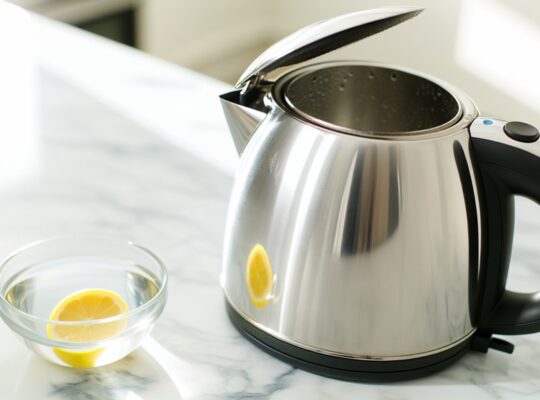
- Descale regularly: a 3–5 mm limescale layer can increase energy use by up to 10–15%; follow manufacturer-safe descaling intervals to maintain efficiency.
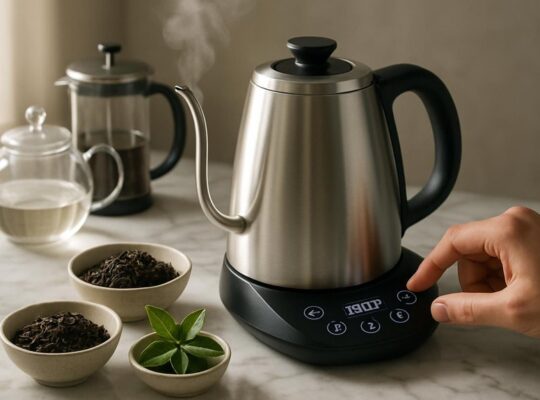
- Choose the right temperature setting if available: lower target temps (e.g., 80°C for green tea) can save 10–25% energy versus full boil, while reducing splatter and steam risks.
Apply these practices consistently; small per-use savings compound, and they won’t compromise safe operation. Remember to identify your kettle type and follow the manufacturer’s manual for proper care and safety.
Environmental Impact: Energy Use and Carbon Emissions
Those small changes you make to save energy at each boil also cut the kettle’s carbon footprint. If your kettle uses 2 kW and a boil takes 0.1 hour, each boil consumes 0.2 kWh. Multiply by your electricity carbon intensity (for example, 0.4 kg CO2e/kWh), and each boil emits about 0.08 kg CO2e. Ten daily boils → 0.8 kg CO2e/day, ~292 kg CO2e/year. These figures scale linearly with boil volume and grid intensity.
To reduce emissions, boil only what you need, keep the kettle descaled for faster heating, and use off-peak or lower-carbon electricity when possible. Track usage: count boils and multiply by kWh per boil to estimate annual emissions. For safety, follow manufacturer instructions for maintenance and never operate with insufficient water. Small, consistent reductions in boil frequency and volume yield measurable carbon savings without compromising safety or convenience. Additionally, using a steamer basket can help prevent cracking when boiling eggs in the kettle.
Choosing the Most Energy-Efficient Kettle for Your Needs
Which features matter most when you want the lowest running costs? You’ll prioritize power rating, capacity, insulation and controls. Pick a kettle with lower wattage only if it still boils quickly; a 2,200 W kettle uses ~0.061 kWh to boil 1 L from 20°C, so efficiency matters more than raw watts. Insulation and a smaller effective capacity cut reheating losses and save energy over time. Safety features like auto-shutoff and boil-dry protection reduce waste and risk.
- Choose appropriate capacity — match kettle size to typical use; heating less water reduces kWh per use.
- Favor good insulation — vacuum or double-wall models retain heat, lowering reheats and standby losses.
- Look for precise controls — variable temperature and quick-boil settings avoid unnecessary full-boil cycles.
- Verify safety certifications — reliable auto-shutoff and thermal cutouts protect you and prevent energy waste.
Track usage for a month to quantify savings and confirm the model meets both efficiency and safety needs. Also consider that kettles with stainless steel construction often provide more even heating and durability, which can improve long-term efficiency.
Frequently Asked Questions
Can a Kettle’s Heating Element Cause Electrical Safety Hazards in Older Homes?
Yes — a kettle’s heating element can cause hazards in older homes if wiring, outlets, or circuits are degraded or undersized; you’ll overload circuits, risk overheating, shorts, or fires. Have an electrician inspect and upgrade as needed.
Do Kettles Use More Energy if Left on a “Keep Warm” Function?
Yes — if you use “keep warm” it uses more energy than shutting off. It draws standby power to maintain temperature, increasing consumption over time; turn it off after heating or use a well-insulated flask to save energy and reduce risk.
How Does Hard Water Affect a Kettle’s Long-Term Energy Use?
Hard water increases scale buildup, which reduces heating efficiency and raises long-term energy use; you’ll likely see higher electricity consumption and potential safety risks. Descale regularly (vinegar or citric acid) and use filtered water to prevent buildup.
Are Cordless Kettles Less Efficient Than Corded Models?
No, cordless kettles aren’t inherently less efficient than corded ones; you’re getting similar element performance. Check wattage, insulation, and lid seal; choose models with good thermal retention and automatic shutoff for safer, more energy-efficient boiling.
Can Boiling Small Amounts Repeatedly Waste More Energy Than a Full Boil?
Yes — repeatedly boiling small amounts can use more energy than one full boil, because each cycle wastes standby and heat-up losses. You should boil only what you need, cover kettles, and avoid reboiling unnecessarily.