When you pick a kettle, the interior material shapes taste, safety, and longevity, so you shouldn’t ignore whether it’s plastic-lined or stainless steel. Evidence shows heated plastics can release additives and microplastics, while grades like 304 or 316 stainless resist corrosion and avoid off-flavors. Choosing a no-plastic interior reduces contamination risk and simplifies care — and there are clear criteria to help you decide which model fits daily use.
Key Takeaways
- Stainless-steel interiors eliminate plastic liners, reducing risk of chemical migration and microplastic contamination into hot water.
- Grades 304 and 316 resist corrosion and maintain flavor integrity under repeated thermal cycles.
- Seamless, welded stainless interiors are easier to clean, preventing scale, oils, and microbial build-up.
- Concealed stainless heating elements and high wattage improve boil speed and reduce limescale traps.
- Look for documented food-grade certification and visible weld quality to ensure true no-plastic purity.
Why Material Choice Matters for Your Kettle
Why does the material inside your kettle matter? You rely on the kettle to heat water safely and predictably, so the interior material determines durability, thermal behavior, and contamination risk. Stainless steel resists corrosion, tolerates repeated thermal cycles, and won’t leach under normal use; these properties are documented in material safety and food-contact standards. Metals like aluminum heat fast but can oxidize; untreated coatings can degrade with scratches. Ceramic interiors offer inert surfaces but may chip. You should prefer materials certified for potable-water contact and tested against prolonged exposure to boiling temperatures. Inspect seals and joints, since failures often arise at interfaces where different materials meet. Regular descaling preserves performance regardless of material. By selecting a kettle whose interior matches regulatory standards and demonstrated long-term stability, you reduce maintenance, avoid unexpected failures, and maintain predictable water quality for daily use. Glass models are corrosion-resistant and make build-up easy to spot, but they are heavier and require careful handling.
Health Risks Associated With Plastic-Lined Interiors
When you heat water in a kettle with a plastic-lined interior, studies show certain additives and monomers can migrate into the water, especially at high temperatures. You’re also exposed to microscopic plastic particles shed from the lining, which recent research links to systemic inflammation and unknown long-term effects. Assessing chemical leaching rates and microplastic release under typical use helps you choose safer, evidence-backed materials like stainless steel. Electric kettles that allow for descaling maintenance tend to remain safer and more efficient over time.
Chemical Leaching Risks
How can tiny amounts of plastic additives in kettle interiors affect your health over time? You’re exposed when heat speeds migration of chemicals like plasticizers, stabilizers and residual monomers into your hot water. Over repeated use, even low-level transfer can produce measurable intake.
- Concern: some additives are endocrine-active and may alter hormone balance.
- Practical risk: chronic, low-dose exposure is linked in studies to metabolic and reproductive effects.
- Emotional impact: knowing everyday tea or coffee can be a repeated exposure source raises justified caution.
Choose materials that limit migration. Stainless steel interiors are non-reactive and resist leaching at boiling temperatures, so you reduce cumulative chemical intake and gain clearer, evidence-based protection for routine use.
Microplastic Contamination
Beyond chemical migration, plastic-lined interiors can shed tiny particles that contaminate your hot drinks. You inhale or ingest microplastics when the lining degrades under heat, an effect documented in lab studies simulating boiling conditions. Particle release increases with temperature cycles, scratching, and age; oils and mineral deposits can accelerate wear. While long-term human health impacts remain under study, microplastics can carry adsorbed chemicals or microbes, raising plausible exposure concerns. Choosing stainless steel interiors eliminates this particulate source and reduces cumulative intake. You should inspect kettles regularly for wear, avoid abrasive cleaning, and prefer durable, high-grade stainless models certified for food contact. That practical approach minimizes both microplastic exposure and uncertain downstream risks.
How Stainless Steel Prevents Flavor Contamination
Stainless steel’s non-porous, tightly bonded surface and corrosion-resistant alloying make it unlikely to react with or absorb flavor compounds, so you won’t get metallic or residual tastes transferred into your water or beverages. You can rely on passivation — the thin chromium-oxide film that forms on stainless surfaces — to block chemical interactions that produce off-flavors. Laboratory studies and industry standards show 18/8 and 18/10 grades resist leaching under normal use; that means your brewed tea or coffee keeps intended aromas without contamination. You’ll also benefit from ease of cleaning: smooth surfaces detach organic residues more completely, reducing microbial or stale flavor carryover. For safety-conscious users, maintaining the oxide layer by avoiding abrasive cleaners preserves these properties. Consider these practical reassurances:
- Confidence: no unexpected metallic taste, so your drinks stay pure.
- Control: predictable material behavior under everyday conditions.
- Hygiene: easier sanitation reduces flavor-degrading residues.
Choose properly specified stainless interiors and follow simple maintenance for consistent, uncontaminated flavor. Many popular models on the market also feature stainless interiors and detachable bases for easier handling and cleaning.
Thermal Performance: Stainless Steel Versus Plastic
Taste integrity matters, but thermal behavior affects your daily experience just as directly — how quickly water heats, how well it stays hot, and how safe the exterior feels are all functions of the kettle’s material. You’ll notice stainless steel conducts heat faster than many plastics, so heating is more efficient and predictable; lab values for thermal conductivity show grade 304 stainless steel around 16 W/m·K versus common engineering plastics below 0.5 W/m·K. That means less energy loss during transfer and more uniform boiling. For heat retention, stainless steel paired with appropriate insulation (double walls, vacuum) outperforms single-wall plastic by minimizing convective and conductive losses. Regarding exterior safety, stainless steel surfaces dissipate heat differently; external insulation is still required to keep touch temperatures low, but the shell won’t soften or release volatiles under repeated high temperatures as some plastics can. If you prioritize efficient heating, stable retention, and material safety, stainless steel is the measured choice. Prestige and Philips both offer stainless steel kettles that exemplify these benefits, making them popular choices in the Indian market with reliable build quality and features like concealed elements and double-wall construction Prestige and Philips.
Durability and Maintenance of Stainless Steel Kettles
How long will a stainless steel kettle last under everyday use? You can expect many years when you care for it correctly: stainless resists corrosion, tolerates repeated heating cycles, and preserves water quality better than plastics. To maximize lifespan, follow measured maintenance steps and safety-minded habits.
- You’ll feel relief when routine descaling keeps performance steady and prevents mineral buildup.
- You’ll gain confidence from inspecting seals and handles for wear before they fail.
- You’ll appreciate the reassurance of simple cleaning with nonabrasive cleaners and verified sanitizing methods.
Descaling frequency depends on local water hardness; test and act when flow or heating slows. Use manufacturer-approved cleaners, avoid harsh abrasives that compromise protective finishes, and replace any degraded gaskets promptly. Regular visual checks and immediate remediation of dents or loose fittings reduce contamination risk and mechanical failure. These practices give you a predictable, safe service life and reduce the chance of sudden malfunctions during daily use. Many users also choose kettles with stainless steel bodies for added durability and easier maintenance.
Common Stainless Steel Grades Used in Kettles
Which stainless steel grade should you look for when choosing a kettle? You’ll commonly see 304 (also listed as 18/8) and 316 (18/10 with added molybdenum). 304 is corrosion-resistant, non-reactive with hot water, and widely used in food-contact applications; it’s suitable for daily boiling and easy to clean. 316 contains molybdenum, improving resistance to chloride-induced pitting and offering greater longevity in hard-water or coastal environments. Both grades are austenitic, non-magnetic in annealed condition, and meet food-safety standards when properly manufactured.
Lower-cost kettles sometimes use 430 (ferritic) stainless steel; it’s magnetic and less corrosion-resistant, so it can be prone to staining or faster degradation under frequent heating. When evaluating kettles, prioritize documented grade information and compliance with food-contact certifications rather than marketing terms. That ensures you’re choosing a material with predictable corrosion behavior and established safety profiles for everyday use. Many reliable 2-litre kettles on the market are made from 304 stainless steel, offering a good balance of durability and value.
Features to Look for When Buying a No-Plastic Interior Kettle
When choosing a no-plastic interior kettle, you’ll want to verify the purity of the stainless steel (look for 18/8 or 304 designations and minimal alloy contaminants). Check objective heating performance indicators like wattage, boil time in independent tests, and presence of even-heat bases or induction compatibility. Finally, confirm safety and maintenance features such as BPA-free seals, cool-touch exteriors, easy-to-clean rounded interiors, and clear descaling guidance. Be cautious about using the kettle for frying or cooking oils because temperature control and safety limitations make such uses risky.
Interior Material Purity
Curious about what “no-plastic interior” really means and why it matters? You want clarity: purity refers to the absence of polymer liners, coatings, or bonded plastic seams in contact with boiling water. Inspect spec sheets for terms like “food‑grade 304/316 stainless steel” and “no internal coatings.” Prefer welded or seamless interiors over glued joints to reduce contamination risk. Verify third‑party testing (NSF, FDA-equivalent) and certificate availability.
- Relief: knowing your kettle won’t leach chemicals into daily beverages.
- Confidence: documented material grades and testing back safety claims.
- Caution: avoid ambiguous marketing phrases that mask plastic components.
Check visible weld quality, ask retailers for test reports, and prioritize transparent manufacturers; those practices minimize exposure and uphold safety.
Heating Performance Indicators
After you’ve confirmed a truly no‑plastic interior, the next practical question is how well the kettle actually heats water — and which measurable features predict reliable, efficient performance. You’ll want to compare wattage (higher watts shorten boil time), element type (concealed stainless steel elements reduce limescale traps), and thermal transfer design (flat, wide bases heat more evenly). Look for clear specifications: wattage in watts, element material, and base surface area in cm² when available. Energy efficiency ratings or manufacturer boil-time claims tested at 1 L are useful quantitative checks. Temperature control precision (±°C) matters if you brew tea or coffee at specific temperatures. Finally, verify tested boil time and consistency in independent reviews rather than relying solely on marketing claims.
Safety and Maintenance
Why should safety and maintenance be top priorities for a no‑plastic interior kettle? You want reliable materials and clear care routines to minimize contamination risk and extend service life. Inspect welds, food‑grade 304/316 stainless markings, and automatic shutoff/boil‑dry protection; these reduce burns and corrosion. Maintenance should be straightforward: descaling, drying, and occasional gasket checks.
- You’ll feel secure knowing every joint and seal is certified and accessible.
- You’ll avoid disappointment when routine descaling restores full performance.
- You’ll appreciate a design that’s easy to clean and resists mineral buildup.
Choose kettles with removable filters, clear manufacturer maintenance schedules, and replaceable parts so you can maintain safety by design, not chance.
Cleaning and Descaling Best Practices
How often should you descale a stainless-steel interior kettle? Descale at least every 4–8 weeks if you have hard water; more often (every 2–4 weeks) when deposits form quickly. Regular visual checks for white or chalky buildup and reduced boil efficiency guide frequency.
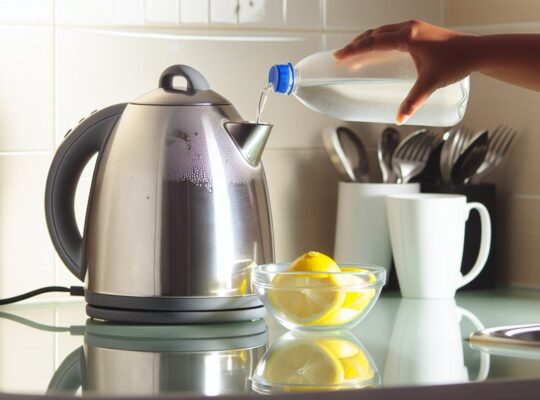
Begin with safety: unplug the kettle and let it cool. Use food-safe descalers—dilute white vinegar (1:1 with water) or a citric-acid solution (1–2 tablespoons per liter). Fill to cover deposits, bring to a near boil, then let sit 20–30 minutes. Swirl gently, pour out, and rinse thoroughly at least three times to remove residual acid. For stubborn scale, repeat the soak rather than scraping, which can scratch and compromise the surface.
For routine cleaning, wash interior with warm, soapy water using a nonabrasive sponge, rinse, and air dry. Store with the lid open to prevent moisture buildup and microbial growth. Regular maintenance preserves safety and performance. Consider using a travel-certified kettle when you need hot water on the go, and always follow any applicable transport or device rules.
Environmental Benefits of Choosing Stainless Steel
Keeping your kettle free of scale not only improves performance but also extends its life, and that longevity is a core environmental advantage of stainless steel. When you choose stainless steel, you’re reducing frequency of replacement; studies show durable materials cut lifecycle emissions by lowering manufacturing demand. Stainless steel is also widely recycled—reprocessing saves substantial energy versus producing primary steel—so end-of-life impacts are smaller when you recycle properly.
You’ll find the environmental case is factual and practical:
- Reduced waste: fewer kettles discarded means less landfill and incineration, which lowers toxic byproducts.
- Lower embodied energy over time: durable use amortizes production energy per use, decreasing your per-use footprint.
- Recyclability: stainless steel retains value for recycling, making reuse pathways realistic and safe.
Follow recommended cleaning and disposal practices to realize these benefits; methodical maintenance preserves both safety and the environmental advantage. Consider also choosing models with automatic shut-off and easy-to-clean interiors to both extend product life and prevent energy waste during use.
Real-World Use Cases and Buyer Recommendations
When you’re choosing a kettle for everyday brewing, focus on how often you’ll use it and the temperatures you need, since stainless interiors retain heat and resist flavor transfer better than plastic-lined models. For most households, mid-range stainless-steel kettles with removable filters and precise temperature controls offer the best value per performance and durability. If you want specific recommendations, I’ll compare top models by capacity, temp accuracy, build quality, and price so you can pick the right balance. Philips models like the HD 9363/02 demonstrate practical features such as flat heating elements and four-way safety systems that are useful in daily use.
Everyday Brewing Scenarios
Think through the ways you actually boil water day-to-day: making single cups of tea, filling a French press for two, prepping hot water for baby formula or instant meals, and hosting small gatherings each demand different kettle performance and safety profiles. You’ll prioritize stainless-steel interiors when contamination risk, heat retention, and cleanability matter. Match capacity, boil speed, and pour control to the task; check for insulated handles, secure lids, and simple descaling procedures. For safety-focused buyers, choose models with automatic shutoff and minimal internal seals that can trap residue.
- Relief: knowing you reduced plastic contact where hygiene matters most.
- Confidence: precise pours and consistent temperatures for each brew.
- Reassurance: durable materials that resist staining and odor retention.
Best Value Picks
You’ve just weighted how stainless-steel interiors map to everyday needs, so now let’s apply that reasoning to specific buys: this section highlights kettles that give the most performance, safety, and longevity per dollar across common use cases. Choose a basic stainless-steel stovetop model if you want minimal parts and easy descaling; it’s cheap, durable, and has no hidden plastic contact points. For frequent office or dorm use, pick an electric stainless kettle with concealed heating element and BPA-free external controls; look for 304/18-8 grade steel and thermostat cutoffs. If you prioritize rapid boiling and scale management, opt for models with higher wattage and removable filters. Always verify manufacturer claims, check for third-party safety certifications, and prefer units with replaceable components.
Frequently Asked Questions
Do Stainless Steel Kettles Affect Microwaving Safety?
No, stainless steel kettles aren’t microwave-safe; they’ll spark, reflect microwaves, and can damage the oven or cause fire. You shouldn’t put metallic cookware in microwaves—use microwave-safe glass or ceramic instead, following manufacturer guidance.
Can Hard Water Cause Stainless Steel Pitting?
Yes — hard water can cause stainless steel pitting over time. You’ll get localized corrosion from chloride-rich scale and deposits; regular descaling, rinsing, and drying, plus using higher-grade stainless, will reduce pitting risk.
Are No-Plastic Kettles Dishwasher-Safe?
Generally, no: you shouldn’t assume kettles are dishwasher-safe. Check the manufacturer’s instructions; many stainless-steel interiors survive machine washing, but electrical bases, seals, or coatings can be damaged, compromising safety and performance. Hand-wash when in doubt.
Do Stainless Steel Kettles Retain Odors From Strong Foods?
Yes — stainless steel can retain faint odors from strong foods, but it’s less absorbent than plastic. Rinse promptly, boil a water-vinegar solution, or scrub with baking soda; those evidence-based methods remove most smells.
How Do Electric Base Materials Interact With Stainless-Steel Bodies?
They generally interact via thermal contact and corrosion resistance: the base’s metal or coated heater transfers heat to the stainless body, and if materials differ or coatings fail, galvanic corrosion or degraded seals can occur, so inspect compatibility regularly.