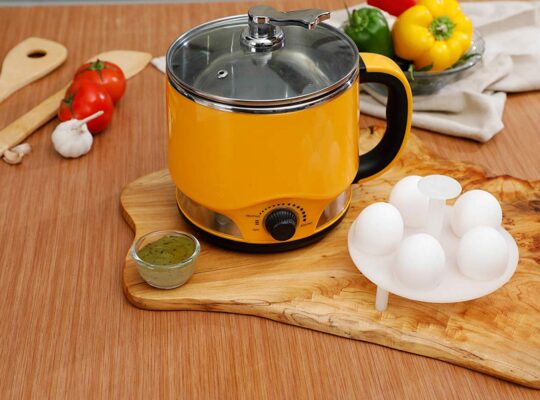
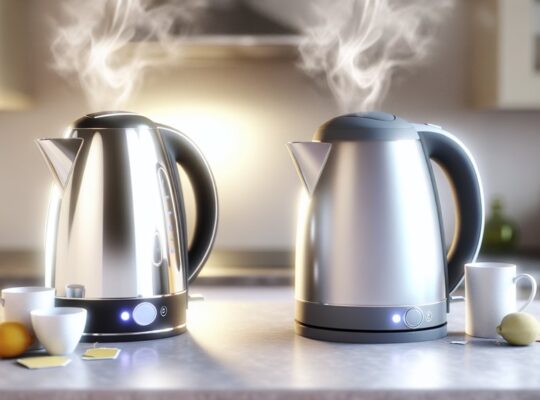
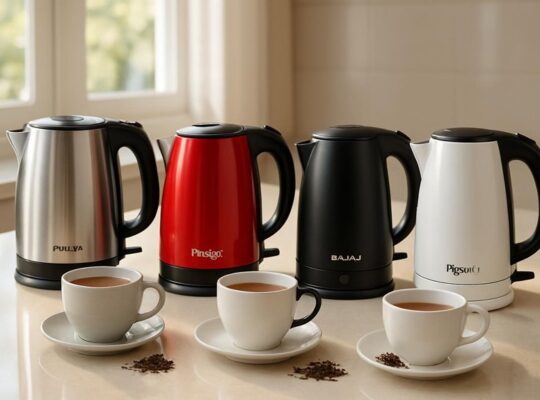
You’re about to pick an electric kettle for a tiny hostel room, so you’ll want something compact, safe, and fuss-free. Think 0.5–0.8 L capacity, auto shut-off, concealed element, and a cool-touch exterior that won’t stress shared sockets. Match wattage to your hostel’s breaker and prefer stainless or BPA-free plastics for durability. Keep going — the right specs will save you space, time, and a lot of hassle.
Key Takeaways
- Choose a 0.5–0.8 L compact kettle with 700–1500 W to save space and avoid overloading hostel circuits.
- Prefer stainless steel or BPA-free plastic, concealed element, cool-touch exterior, and auto shut-off for safety and durability.
- Verify plug type, socket amp rating (6–10 A), earthing, and avoid using multiple high-watt appliances on one circuit.
- Look for cordless base, removable limescale filter, clear water markings, and easy-to-clean wide mouth for shared use.
- Descale every 2–4 weeks, store cords off the floor, label the kettle, and report faults—don’t attempt DIY electrical repairs.
Why a Compact Electric Kettle Is a Hostel Essential
Ever wondered how to shave minutes off your daily routine without sacrificing hot drinks or instant meals? A compact electric kettle‘s your covert efficiency tool: it boils water fast, uses less power than a stove, and fits cramped hostel counters. You’ll appreciate models with 0.5–1.0 litre capacity — enough for tea, instant noodles, or a quick soup, without hogging space or weight in a shared cupboard. Look for cordless bases, concealed heating elements, and cool-touch handles so you can transport hot water safely. Rapid boil and auto-shutoff features keep things convenient and reduce risks, while removable limescale filters help maintain hygiene where water quality varies. Energy-saving ratings and simple, one-button controls make operation foolproof at odd hours. Compact kettles also cut cleanup: few parts, quick dry time, minimal spills. In short, a small, well-designed kettle boosts independence, saves time and energy, and fits the realities of hostel living without complicating your routine. Consider a foldable silicone model for ultimate portability and space-saving convenience foldable silicone.
Safety Checks for Indian Hostels and Sockets
Check the socket’s ampere and voltage rating before you buy a kettle so you don’t overload a 6–10A outlet with a high-wattage appliance. Make sure the kettle’s plug matches the hostel sockets (Type C/D/M) and that pins fit snugly without wobble. Also look for evidence of proper earthing and ask if the hostel has overload or earth-leakage protection on the circuit. Place the kettle on a stable, heat-resistant surface away from edges and heat sources to reduce risk of accidents and electrical issues, and always verify the cord is intact before use with automatic shut-off functioning properly.
Socket Rating & Ampere
Wondering whether your hostel socket can handle a 1500 W electric kettle? You should check socket rating and available amps before you plug in. Most hostel sockets are 6A–16A; a 1500 W kettle at 230V draws ~6.5A (1500/230 ≈ 6.5). Still, inspect wiring condition and distribution to avoid overloads.
- Confirm socket label or ask maintenance for ampere rating.
- Ensure no multiple high-watt appliances run on the same circuit.
- Look for signs of overheating: discolouration, burn marks, loose fit.
- Use a dedicated socket or a properly rated extension with surge protection.
If in doubt, choose a lower-wattage kettle or consult your electrician to prevent tripping or fire risk.
Plug Type Compatibility
After confirming socket amp rating, next you’ll want to verify plug compatibility so your kettle fits safely and supplies power correctly. Check that the kettle’s plug matches the hostel outlet type—most Indian hostels use Type D (three round pins) or hybrid Type C/D sockets. If the kettle has a detachable cord, confirm the IEC or country-specific connector is compatible or get an approved replacement cord. Avoid forcing adapters; use only robust, certified adapters with proper pin spacing and insulation if absolutely needed. Ensure the plug’s pin thickness and earth pin length match the socket to maintain grounding. Finally, inspect pins for corrosion or loose fit, and replace any damaged plug with a certified one to prevent heat, sparks, or poor contact.
Overload & Earth Leakage
How can you make sure your hostel socket won’t overload or leak current when you plug in a kettle? Check load ratings: a typical 1500–2000 W kettle draws ~6–9 A; confirm sockets and extension cords are rated above that. Look for earthing and RCDs: ensure the hostel has proper earth wiring and that sockets or main boards use an RCD/MCB to cut power on leakage. Test before use: try another high-wattage appliance to see tripping behavior.
- Verify plug and socket are undamaged, no burn marks.
- Use only good-quality, thick-gauge extension leads with earth.
- Avoid daisy-chaining appliances on one outlet.
- If you detect tingling, sparks, or frequent trips, stop and report.
Safety first; don’t improvise with cheap adapters.
Ideal Capacity and Size for Cramped Rooms
Think small but smart: for cramped hostel rooms you’ll want a kettle between 0.5–1.0 litre — compact enough to sit on a desk or shelf, yet large enough to make 1–3 cups without reheating constantly. You’ll appreciate a slim footprint and vertical profile that leaves room for a laptop or study lamp. Pick lightweight materials and a low center of gravity so it won’t tip on crowded surfaces. Look for clear max-fill markers and a safe-lock lid to avoid spills. Handle comfort and cool-touch exterior matter when space limits your options for placement.
| Feeling | Practical pick |
|---|---|
| Relief | 0.5–0.8 L slim kettle |
| Confidence | Clear markings, auto-shutoff |
| Safety | Cool-touch, secure lid |
| Ease | Cord storage, compact base |
You’ll want something easy to clean and quick to store. Prioritize safety features over extra bells so your small space stays secure and functional. A reliable brand with proven quality like prestige electric kettle can save you maintenance headaches down the line.
Power, Voltage Compatibility, and Fuse Considerations
Curious what to check so your kettle won’t trip fuses or underperform? You’ll want to match kettle power (wattage) to your hostel’s electrical limits. Most Indian hostels supply 230 V; confirm that the kettle rating says 220–240 V. High-wattage kettles (1500–2000 W) heat fast but can overload weak wiring or old fuses. Choose a lower-wattage model if circuits are shared.
- Check the label: voltage (220–240 V) and power (W).
- Inspect hostel wiring: ask maintenance about circuit rating and fuse type (MCB vs. fuse).
- Prefer kettles with thermal cut-off and auto shut-off for safety.
- Use a single dedicated socket; avoid extension cords or multi-plugs on the same line.
If unsure, pick a 1000–1500 W kettle and test briefly; persistent tripping means consult staff. These steps keep your kettle reliable and safe without stressing hostel electrics. Boil only the required amount of water and clean regularly to prevent limescale buildup which can reduce heating efficiency.
Fast Boil Time Vs Energy Consumption Trade-Offs
If you want hot water fast, higher-wattage kettles cut boil time but draw more current—check hostel limits before choosing speed over convenience. Consider energy per cup: a smaller kettle or boiling only what you need often uses less total electricity than repeatedly heating a large pot. Also weigh insulation and standby losses—better double-walled models keep water hot longer, saving energy overall even if initial boil is marginally slower. Read the manufacturer’s manual and inspect the kettle before use for automatic shut-off and other safety features.
Boil Speed Vs Power
Wondering whether a faster boil is worth the extra power draw? You’ll balance convenience, safety, and your hostel’s limited electrical capacity. Higher-watt kettles (1500–2200W) boil quickly but stress small circuits; lower-watt models (700–1200W) are gentler on wiring and safer in shared rooms. Consider your routine and breakers, and always use grounded sockets.
- Faster boil saves time when you’re in a rush but can trip fuses on old hostel wiring.
- Lower power reduces load and heat, lowering risk of overheating and circuit overload.
- Match kettle wattage to your room’s socket rating and avoid daisy-chaining extensions.
- Prefer automatic shut-off and boil-dry protection to mitigate risks regardless of power.
Choose a wattage that fits your schedule and electrical safety limits.
Energy Per Cup
How much energy does it actually take to boil the cup you drink? You’ll balance fast boil times against higher wattage and slightly more energy per cup. If you only heat the water you need, a 1‑cup boil uses ~0.05–0.1 kWh depending on kettle efficiency. Faster 2000–3000 W kettles cut time but draw more current; slower 1500 W models take longer yet can be marginally more efficient if you pour accurately.
| Scenario | Power (W) | Typical Energy per Cup (kWh) |
|---|---|---|
| Quick boil | 2500 | 0.09 |
| Standard | 1500 | 0.07 |
| Small cup | 1000 | 0.05 |
| Large mug | 3000 | 0.12 |
Measure, pour only what you need, and avoid unsafe overfilling.
Insulation and Standby
A well-insulated kettle lets you keep water hot longer without reheating, but that convenience can hide standby energy use you might not notice; choosing thicker walls and vacuum or foam insulation reduces heat loss, so you boil less often, while poor insulation forces frequent reheats that erase any time saved by a high‑wattage, fast‑boil element.
You’ll balance fast boil time against overall energy use: a 1500–2200W element cuts boil time but draws more current, while insulation determines how often you reheat. Look for models with low standby heat loss, clear capacity markings, and automatic shutoff for safety.
- Vacuum or double‑wall insulation minimizes losses and scald risk
- Lower wattage + better insulation can save energy over a day
- Check for reliable auto‑cutoff and boil‑dry protection
- Prefer stainless interior for durability and safe heating
Key Features: Auto Shut-Off, Boil-Dry Protection, and Filters
Why should you care about auto shut-off, boil‑dry protection, and filters? You want a kettle that shuts off the instant water reaches boil, prevents heating with no water, and keeps scale out of your cup. Those features cut fire risk, save power, and protect health.
| Feature | What it does | Why it matters |
|---|---|---|
| Auto shut-off | Stops heating at boil | Prevents overflow, saves energy |
| Boil-dry protection | Detects no/low water | Avoids element burn-out, fire risk |
| Filter (mesh or removable) | Catches limescale | Improves taste, extends element life |
When choosing, confirm automatic circuitry (not just manual timers), reliable thermal sensors for boil-dry, and a removable, fine mesh filter you can clean. Look for clear LED indicators and audible alerts so you’ll know status in noisy hostels. Prioritise models with safety certifications and easy-to-clean filters; they reduce maintenance and keep your hot water safe every day. The 1500W to 2000W power range found in many popular models ensures rapid boiling and energy-efficient performance, making it ideal for hostel use with limited time and shared facilities rapid boiling.
Build Materials, Durability, and Easy-Clean Options
When you pick a kettle, body material matters for heat retention, weight, and safety—stainless steel is durable, glass looks premium but needs careful handling, and plastic is lightweight but can retain odors. Check for removable limescale filters, wide openings for easy scrubbing, and dishwasher-safe parts to keep maintenance simple. Prioritize a build that fits your routine so you’re not stuck cleaning or replacing it mid-semester. Also consider double-walled construction for better insulation and cooler exterior temperatures.
Body Material Choices
Curious which kettle body will survive dorm life and still be easy to clean? You want a safe, durable choice that’s low-maintenance and won’t leach flavors. Consider materials based on toughness, heat resistance, and hygiene. Here’s a quick comparison to help you pick:
- Stainless steel: Robust, corrosion-resistant, no plastic contact with water; ideal for long life and safety.
- Glass: Lets you see limescale, looks modern, but is heavier and breaks more easily—good if you handle it carefully.
- BPA-free plastic: Lightweight and affordable; ensure no hot-water contact with hidden plastics and pick food-grade labels.
- Composite/painted metal: Stylish but check coating durability—scratches can trap bacteria and reduce safety over time.
Choose based on your handling habits and safety priorities.
Cleaning & Maintenance
You’ve picked a body material that matches your handling habits — now think about how easy it’ll be to keep the kettle clean and working over months in a hostel. Choose stainless steel or glass interiors: they resist stains, don’t leach, and withstand repeated descaling. Avoid poorly coated plastics that scratch and trap bacteria. Look for removable, wide-mouth lids and non-removable heating elements versus concealed coils — concealed coils cut limescale buildup and simplify wiping.
Prioritize kettles with clear descale instructions and customer-available replacement parts (filters, lids, bases). Check for IP-rated bases or splash-resistant designs to prevent shorting. Regularly descale with vinegar/citric acid per manual, rinse thoroughly, and dry before storage. Proper maintenance preserves safety, heating efficiency, and your hostel peace of mind.
Travel-Friendly and Space-Saving Designs
Need something compact that fits a cramped hostel shelf and your backpack? You’ll want a kettle that’s small, light, and built with safe materials and sensible features so you can move between mess halls, classes, and trips without risk.
- Collapsible or slim-profile kettles: saves inches of shelf space and slips into luggage; check for BPA-free silicone and heat-resistant handles.
- Detachable-base models: base stays on the counter while the jug goes in your bag; ensures cord protection and safer transport.
- Low-capacity options (0.5–0.8 L): you’ll boil only what you need, cut energy use, and reduce weight for travel.
- Cord-wrap and travel locks: prevents accidental spills and keeps cord tidy during transit; look for locking lids and auto-shutoff.
Pick units with clear safety certifications, dry-boil protection, and sturdy exteriors. You’ll get convenience without compromising safety — essential when you’re juggling cramped spaces, roommates, and occasional hostel power quirks. AGARO models often include useful features like auto shut-off that add an extra layer of safety for hostel use.
Budget Ranges and Value-For-Money Brands in India
How much kettle can you obtain on a student budget in India? You can secure safe, fast boiling kettles from ₹700–₹2,500. For ₹700–1,200 expect compact plastic models with auto shut-off; for ₹1,200–2,000 get stainless steel shells and better heating; above ₹2,000 you’ll find cordless, faster, and branded warranties. Prioritize safety features (auto cut-off, boil-dry protection) and clear power ratings.
| Price band | Typical strength |
|---|---|
| ₹700–1,200 | Cheapest, lightweight, basic safety |
| ₹1,200–2,000 | Balanced, stainless body, reliable |
| ₹2,000–3,000 | Branded, cordless, faster |
| 3,000+ | Premium, extra features, longer warranty |
Value-for-money brands to consider: Bajaj and Prestige for affordability; Philips and Havells for reliability; Morphy Richards for features. Compare wattage, material, and warranty; choose a model that’s safe, energy-efficient, and repairable nearby so you stay secure in shared housing. A simple routine of regular descaling will keep the kettle efficient and tasting better.
When you’re sharing a hostel room or common kitchen, quick, regular upkeep keeps your kettle safe and prevents conflicts—wipe the exterior after each use, descale every 2–4 weeks depending on water hardness, and never leave residue or damp cloths inside the storage base. You’ll also want to follow basic safety routines so everyone stays safe and devices last.
- Unplug and cool before cleaning: avoid water near the base and cord, use a damp cloth for the outside and a soft brush for the spout.
- Descale with vinegar or citric acid: run a half-solution, boil, cool, rinse twice; more often if your water’s hard.
- Store cords neatly and off the floor: prevents trips and protects connectors from moisture.
- Label and own responsibility: mark your kettle, set a cleaning rota, and report faults immediately.
Treat the kettle like shared tech: keep firmware-like care (regular checks), don’t improvise repairs, and replace units showing exposed wiring or persistent faults. Many hostels prefer stainless steel kettles because they avoid plastic parts and are easier to maintain.
Frequently Asked Questions
Can I Use an Electric Kettle to Heat Milk or Soups Safely?
Yes — you can, but be cautious. Don’t boil milk repeatedly; scorch and overflow risks exist. Use kettles with wide mouths and easy-clean stainless interiors, stop before boiling for soups, and clean thoroughly after each use.
Will a Kettle With an Exposed Coil Trap Dirt or Pests?
Yes — exposed-coil kettles can trap residue, dust and insects around the heating element, making cleaning harder and raising hygiene risks. You’ll want a concealed-element model or frequent deep cleaning to keep things safe and sanitary.
Can I Run a Kettle on a UPS or Power Bank Inverter?
Yes — but you shouldn’t. Most UPSes/power-bank inverters can’t handle a kettle’s high wattage; they’ll overload, trip, or overheat. Use a unit rated for the kettle’s watts or choose a low-power model (travel kettle).
Are There Noise Levels Differences Between Kettle Models?
Yes — you’ll notice differences: rapid-boil stainless kettles can hiss or click, plastic models are often quieter; quieter kettles use insulated bases and quieter elements. Check decibel specs, customer reviews, and safety certifications before buying.
Do Kettle Warranties Cover Hostel-Living Damages or Misuse?
No — warranties usually won’t cover hostel-specific damage or misuse. You’ll be protected for manufacturing defects or electrical faults if you follow instructions; accidental drops, burns, tampering or improper voltage use are typically excluded.