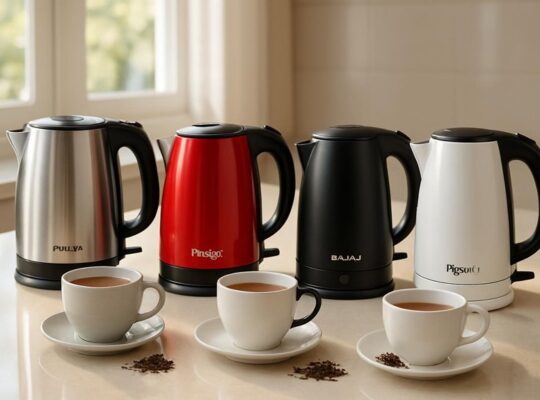
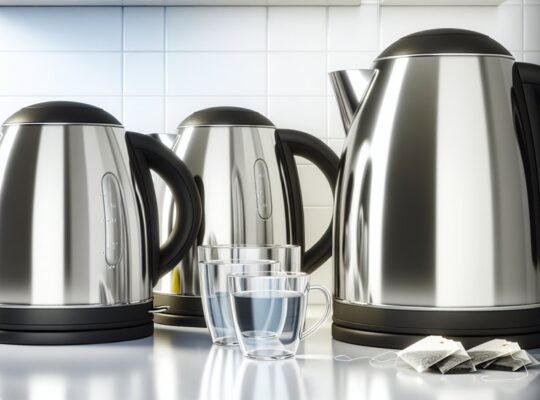
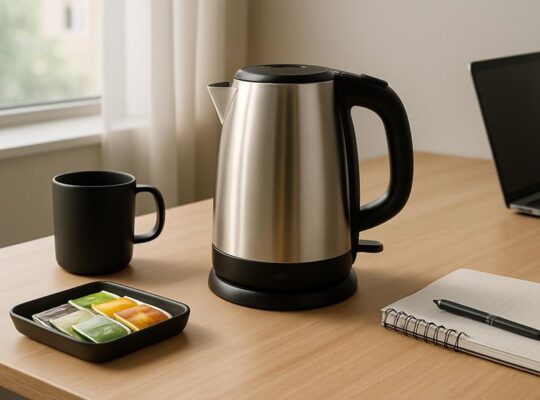
If you share a small office, you want a kettle that’s quiet, compact, and reliable. You’ll look for low vibration, cool-touch housing, and a 0.5–1.0 L size that won’t dominate a counter. Cordless bases, easy-fill windows, and automatic shut-off matter for safety and convenience. Pick the right material and maintenance routine, and you’ll avoid noise and hassle—here’s what to consider next.
Key Takeaways
- Choose a compact 0.5–1.0 L cordless kettle with a slim footprint and integrated cord storage for tight office counters.
- Prioritize quiet-boil designs: insulated housing, concealed element or induction, and sealed lid to minimize rumble and whistles.
- Confirm safety features: automatic shut-off, boil-dry protection, cool-touch exterior, non-slip base, and relevant certifications.
- Look for stainless steel or borosilicate glass interiors, removable wide mouths, and easy-descale guidance to maintain taste and efficiency.
- Balance wattage and capacity: higher watts for fast boils but prefer variable-volume or rapid-boil settings to save energy.
Why should you care about a quiet, compact kettle in a shared workspace? You’ll reduce noise disruption, preserve concentration, and keep meetings from being interrupted by loud boiling. A compact model fits limited counter space and prevents clutter, so communal areas stay orderly and safe.
You’ll also minimize risk: smaller kettles are easier to move, store, and inspect for damage, lowering the chance of spills or burns. Quieter operation means you won’t startle colleagues or mask safety signals, which is crucial in emergency situations. Choosing compact, low-noise appliances supports predictable behavior — people won’t crowd around a bulky unit, reducing trip hazards and overuse.
From a practical perspective, you’ll save energy and time with faster heats in a small volume, cutting run time and exposure to hot surfaces. In short, a quiet, compact kettle lets you enjoy hot drinks without compromising focus, safety, or shared-space hygiene. Regular descaling with vinegar solution helps maintain efficiency and prevents limescale buildup.
Key Features to Look For in an Office Electric Kettle
When choosing an office kettle, you’ll want one that boils quietly so it doesn’t interrupt colleagues or conference calls. Also pick a model with a compact footprint that fits limited counter space and common breakroom layouts. Together, quiet boil performance and small size keep your office efficient and unobtrusive. Consider a model with automatic shut-off to prevent accidents and save energy.
Quiet Boil Performance
A few key boil characteristics determine whether an office kettle will stay unobtrusive: noise level, boil time, and heating method. You’ll want a kettle that minimizes audible rumble and high-pitched whistles; look for designs with insulated housings, low-vibration elements, and sealed lids. Faster boils reduce time spent near the unit, but ultra-fast heating can increase noise — balance speed with silence. Induction or concealed-element kettles often run quieter than exposed coils. Also consider steam control and soft-start features that limit sudden bursts and reduce splatter risk. For safety, choose models with automatic shut-off, boil-dry protection, and cool-touch exteriors so quieter operation doesn’t compromise safeguards. Prioritize certified units and real-user noise tests when comparing options.
Compact Footprint Design
Think small but purposeful: in an office you’ll want a kettle that saves counter space without sacrificing capacity, stability, or ease of use. Choose a model with a slim base and vertical profile so it tucks beside a coffee maker or sink. Measure available surface area and compare footprint specs rather than relying on photos.
Prioritize kettles with a low center of gravity and wide, non-slip base to prevent tipping when the office is busy. Look for integrated cord storage to avoid trip hazards and a compact handle that doesn’t add bulk. Materials should be cool-touch or insulated to reduce burn risk in shared spaces. Finally, favor designs that balance minimum footprint with a usable fill level—small shouldn’t mean underpowered.
Top Quiet Electric Kettle Models for Small Desks
Looking for a kettle that won’t wake the office or hog your desk? You’ll want models that balance low noise, small footprint, and safety features. Pick a kettle with quiet boiling technology (insulated housings and gentle heating elements) so you won’t disturb colleagues. Choose capacity around 0.5–1.0 L to fit narrow desks and limit energy use. Look for automatic shutoff, boil-dry protection, and cool-touch exteriors to reduce risk in shared spaces. Stainless steel or BPA-free inner linings are safer for water taste and health. Evaluate noise measured in dB if provided — lower is better — and prefer kettles with smooth lids to avoid sloshing sounds. Prioritize stable bases with non-slip feet and short cords to prevent trips. If you often make single cups, models with precise pour spouts and quick heat times will save time without extra noise. You’ll get compact convenience while keeping safety and office etiquette top of mind. Regular descaling with white vinegar helps prevent mineral buildup and keeps kettles boiling efficiently.
Best Cordless Kettles for Easy Sharing and Storage
You’ll want a cordless kettle that lets you pour cleanly with one hand, so cups can be passed around without spills. Look for compact designs with tangle-free bases or detachable cords that tuck away for easy storage. Quiet rapid boiling matters too — it keeps the office calm while still getting water fast. Consider models with auto turn on and off for added safety and convenience.
Easy One-Handed Pouring
Need to pass a mug while juggling files or a phone? You’ll want a kettle that pours smoothly with one hand, stays stable on its base, and has a secure lid and cool-touch handle. Look for ergonomic spouts that prevent drips, balanced weight for controlled flow, and a reliable auto-shutoff for safety. Test how the kettle feels when full and how the trigger or lift works under typical office conditions.
| Feature | Why it matters | Quick check |
|---|---|---|
| Spout design | Prevents scalding drips | Look for narrow, tapered pour |
| Handle ergonomics | Reduces wrist strain | Grip comfort when full |
| Safety locks | Stops accidental spills | Secure lid and auto-off |
Choose models that pass simple in-hand trials before buying.
Compact Tangle-Free Storage
Want a kettle that disappears into a drawer or shifts easily between desks? You’ll value a cordless base with a short, retractable, or detachable power cord that stores neatly beneath the unit — no trailing wires to snag or tangle. Pick models with a flat base profile and compact footprint so they fit shared cupboards or under shelves. Look for a secure lid latch and heat-insulated handle to prevent burns when you’re moving it between workspaces. A clear indicator for water level and a cool-touch exterior let you handle it confidently, even in busy offices. Prioritize proven build quality and a cord-stow mechanism rated for repeated use so storage stays tidy and safe.
Quiet Rapid Boiling
A quiet rapid-boil kettle cuts down wait times without turning your office into a noise zone: look for models that combine powerful, efficient heating elements with noise-dampening design (insulated chambers, thicker walls, and anti-vibration bases) so water reaches boiling quickly while keeping sound levels low. You’ll want a kettle that boils fast but also stops reliably—automatic shutoff, boil-dry protection, and cool-touch exteriors are non-negotiable for shared spaces. Choose cordless, compact units with secure lids and pour spouts to prevent spills when serving colleagues. Check wattage: higher watts mean quicker boils but need adequate outlets and circuit capacity. Read decibel specs or user tests, prioritize reputable brands with safety certifications, and balance speed, silence, and safe operation for stress-free office use.
Space-Saving Designs for Tight Office Kitchens
Looking for a kettle that fits a crowded office counter without sacrificing function? You’ll want compact footprints, vertical profiles, and models that tuck into tight corners without blocking outlets or walkways. Pick kettles with slim bases or gooseneck shapes that reduce horizontal spread; they’re easier to store on narrow shelves and keep spill risk low. Consider cordless designs with removable bases so you can place the kettle closer to users and lift it away for pouring without awkward maneuvers. Stackable lids or flat-top designs save overhead space in cupboards. Look for clear, well-marked water windows and secure locking lids so safety isn’t compromised by the smaller size. Measure your busiest counter and compare with product dimensions rather than relying on labels like “compact.” Finally, prioritize units with stable, non-slip bases and automatic shutoff — features that maintain safety in cramped, high-traffic office kitchens where accidents are more likely. Brands like Philips offer reliable compact models and strong after-sales support you can count on.
Energy Efficiency and Fast-Boil Performance
How quickly your kettle boils and how much energy it uses will directly affect office running costs and downtime, so you’ll want a model that balances fast-boil performance with low power waste. You’ll look for kettles that hit boil fast on a single cup setting and maintain efficiency when filling only what’s needed.
Consider these practical performance factors:
- Rapid-boil heating elements: get fast heat-up times with low standby loss.
- Variable volume settings: boil only what you need to reduce wasted energy.
- Insulation quality: better thermal retention cuts reboil cycles.
- Power rating vs. capacity: higher watts speed boil but watch energy per ml.
- Heat distribution design: flat bases and concealed elements improve transfer.
You’ll compare measured boil time for typical office volumes (250–1000 ml) and estimate kWh per day. Pick a compact model that matches your busiest use patterns so you reduce costs and interruptions while keeping a safe, predictable boil profile. Tesora’s premium glass models also offer boil dry protection that improves safety and reliability.
Safety Features Important in Office Settings
You’ll want kettles with automatic shut-off so they don’t keep heating after reaching a boil and to prevent accidents if someone forgets them. Boil-dry protection is essential in an office where water levels can be overlooked—it stops the element from burning out. A cool-touch exterior lets people handle the kettle or move it between desks without risking scalds. For added convenience and safety, choose models with automatic shut-off and boil-dry protection so they’re suitable for shared office use.
Automatic Shut-Off
Automatic shut-off is a must for office kettles because it prevents boil-dry damage and reduces fire risk if someone forgets to turn it off. You want a kettle that reliably cuts power when water reaches boiling or when the tank is empty, so you’re not policing coworkers or worrying after hours. Evaluate models for responsiveness, consistent activation, and clear indicator lights. Prefer units with tested electrical certifications.
- Rapid, reliable shut-off reduces unattended-heat incidents
- Clear visual/audible cues confirm the kettle powered down
- Fail-safe design minimizes user intervention and liability
- Low maintenance mechanisms are less likely to fail over time
- Certifications and warranties back manufacturer claims
Choose a kettle that balances performance with documented safety features for peace of mind.
Boil-Dry Protection
Why risk a scorched element or worse when a kettle can protect itself? You want a unit that detects low or no water and stops heating immediately — that’s boil-dry protection. It prevents overheating, fire risk, and premature failure, which matters in shared offices where someone might forget to refill. Evaluate kettles by response time, reliability, and clear indicator alerts. Prefer models with automatic cut-off plus thermal sensors rather than simple timers.
| Feature | Why it matters |
|---|---|
| Sensor type | Faster, more accurate shut-off |
| Indicator alert | Lets you know why it stopped |
| Reset method | Easy manual restart vs. service required |
Pick a kettle with proven safety certifications and straightforward diagnostics for peace of mind.
Cool-Touch Exterior
How cool should the outside of a kettle feel when it’s been boiling for a minute or two? You want assurance the exterior stays safe to touch so coworkers, guests, and you won’t get scalded. Prioritize models with tested cool-touch housings and clear labelling.
- Reduces burn risk for accidental contact
- Lets you move or lift without oven mitts
- Keeps shared spaces safe for varied users
- Signals better internal insulation and build quality
- Often pairs with automatic shutoff for added safety
When evaluating, check independent safety certifications and read real-user reports about surface temperature. If you handle hot liquids for many colleagues, pick a kettle whose surface stays noticeably cooler than traditional metal designs — that choice minimizes incidents and gives you practical peace of mind.
Materials, Durability, and Ease of Cleaning
Curious which materials will give you the quietest, longest-lasting kettle? You’ll want stainless steel or BPA-free glass for reliability and safety. Stainless steel resists dents, won’t leach chemicals, and dampens vibration better than thin metals — that helps with quieter boils. Glass shows scale buildup so you can spot and descale it promptly; choose borosilicate for thermal shock resistance. Avoid kettles with exposed thin aluminum or low-grade painted metal; they scratch, corrode, and can amplify noise.
Check seams, lid fit, and the kettle-to-base connection for solid construction; loose parts rattle and shorten lifespan. Look for removable, wide mouths and flat heating elements or concealed coils — they’re easier to clean and reduce crevice buildup that harbors bacteria. Removable filters are a safety and maintenance plus; they catch limescale and make rinsing simple. Prioritize models with clear cleaning instructions and accessible replacement parts to keep your office kettle safe, quiet, and durable for years. Consider a stainless steel model like the Orpat OEK-8137 for its durable design and quiet operation.
Price Ranges and Value Picks for Offices
Looking for the best value for your office budget? You want a kettle that’s safe, reliable, and cost-effective. Below are practical price tiers and representative features so you can pick what balances upfront cost with long-term value.
- Budget (under $30): basic stainless or plastic models, safety auto-shutoff, limited noise control — good for low-use spaces.
- Mid-range ($30–$70): better insulation, quieter boiling, durable heating elements, clearer temperature settings — solid everyday choice.
- Premium ($70–$150): precise temperature control, double-wall for cooler exteriors, advanced safety features, quieter operation.
- Compact/single-serve options: lower cost, minimal footprint, ideal for small teams or shared desks; check safety certifications.
- Office fleet buys: buy slightly above budget for bulk durability and warranty support; reduces replacements and safety incidents.
Compare warranty length, certified safety marks (UL/ETL), and energy efficiency. Prioritize stability and automatic shutoff over bells to keep your office safe and costs predictable. Many multipurpose kettles also include auto shut-off features and concealed heating elements that improve safety and ease of cleaning.
Want to keep your shared office kettle safe and reliable? You should set clear rules, assign basic upkeep, and choose simple, safety-first practices. Empty and dry the kettle after long weekends, descale monthly with vinegar or citric acid, and check the cord and auto-shutoff regularly. Label a cleaning schedule and appoint a rotating steward so accountability’s visible.
| Task | Frequency |
|---|---|
| Empty & dry | Daily |
| Descale | Monthly |
| Inspect cord & spout | Weekly |
| Replace filter or parts | As needed |
Use filtered water to cut scale and avoid boiling dry — it strains the element. Train colleagues on safe pouring and lid closure; post quick instructions near the kettle. If you notice strange noises, odor, or inconsistent shutoff, unplug and remove the unit from service until inspected. Keeping procedures simple, visible, and enforced reduces risk and extends the kettle’s life, so everyone gets hot drinks without safety compromises. Always prioritize automatic shut-off when selecting or approving a shared kettle.
Frequently Asked Questions
Can I Use an Electric Kettle for Baby Formula Preparation in the Office?
Yes — you can, but you’ll need caution. Boil then cool water to the recommended temperature, use a clean kettle, avoid reboiling repeatedly, and store formula safely. Check your baby’s guidance and office policies first.
Are Quiet Kettles Compatible With Communal Smart Plugs or Timers?
Yes — quiet kettles usually work with communal smart plugs or timers, but they’ll need to fully power on; make sure the plug supports the kettle’s wattage, avoids auto-shutoff conflicts, and follows office safety and appliance policies.
Do Office Kettles Interfere With Nearby Medical Devices or Monitors?
Unlikely — most modern office kettles are low‑power and don’t emit strong RF, so they shouldn’t interfere with medical monitors. Still, you’ll want to keep distance, check device manuals, and consult facility safety if in sensitive areas.
Can I Brew Tea Leaves Directly in a Glass Office Kettle?
Yes — you can, but only if the kettle’s designed for loose leaves or has a built-in infuser or removable filter. Otherwise leaves clog spouts and damage heating elements; always follow manufacturer cleaning and safety instructions.
You’ll get manufacturer warranties, extended plans, and sometimes institutional service contracts; check coverage for spills, electrical faults, and wear. You’ll want clear shared-use policies, prompt repair timelines, and liability/cleaning responsibilities defined.