If you brew tea or coffee at home, you’ll want a kettle that hits precise temps and holds them reliably. Compare models by temperature accuracy, presets, hold time, and build materials like stainless steel or glass. Watch for safe auto shut-off, boil-dry protection, and concealed elements for easier cleaning. I’ll outline top picks, budget choices, and what specs matter most so you can pick the right kettle for your routine.
Key Takeaways
- Choose kettles with PID or microcontroller temperature control for ±1–2°C accuracy and stable hold functions.
- Prefer concealed stainless-steel flat elements, food-grade interiors, and tight lids for faster heating and easier descaling.
- Verify safety features: auto shut-off, boil-dry protection, cool-touch handle, and relevant certifications (BIS/CE).
- Match wattage to capacity (around 1500–2200 W for 1–1.7 L) to balance speed and long-term reliability.
- For India, pick models with clear digital readouts, multiple preset temperatures, easy-to-clean filters, and good after-sales support.
Why Temperature Control Matters for Tea and Coffee
Why does exact temperature matter? You’re controlling extraction chemistry: different teas and coffees release acids, oils, and aromatics at specific temperatures. Green tea releases bitterness if water exceeds ~80°C; black tea needs near-boil to extract tannins; delicate single-origin coffee benefits from a stable 92–96°C pour. Precise temperature reduces over-extraction and under-extraction, so you’ll get predictable flavor profiles and avoid bitter or flat brews.
From a safety and efficiency standpoint, temperature control minimizes scald risk by preventing unnecessary boiling and reduces energy waste by heating only to the required setpoint. Compared to variable wait-and-taste methods, controlled-kettle use offers repeatable results and safer handling—less risk of sudden boil-overs or steam burns. You’ll also protect equipment and ingredients: overheating can degrade leaves and oils, while consistent temperatures extend component lifespan. Overall, exact temperature gives you reproducible flavor, lower hazard, and optimized energy use. Using a certified kettle with automatic shut-off and overheat protection further reduces safety risks on the go automatic shut-off.
Types of Temperature Control in Electric Kettles
How do kettles control temperature, and what options should you consider? You’ll see three primary systems: single-set thermostats, variable thermostatic controls, and PID/microprocessor regulation. Single-set thermostats are simple bimetal or thermal cutouts that switch off at one predefined point—reliable for safety but inflexible for specific brew temperatures. Variable thermostatic controls use adjustable thermostats or stepped presets, letting you choose from several fixed temperatures; they’re convenient but less precise. PID or microprocessor regulation combines temperature sensors (NTC/thermistors) with feedback algorithms to maintain setpoint accuracy within a degree or two; this delivers the best stability for delicate brews and reduces overheat cycles. Also note sensor placement and response time: sensors near the heating element give faster feedback but must be water-resistant and insulated to meet safety standards. For safe operation, prioritize systems with automatic shutoff, dry-boil protection, and clear temperature readouts aligned to the control type. Many reliable models also include flat heating elements which improve boiling efficiency and are easier to clean.
Key Features to Look For When Buying
Which features matter most when you’re choosing a temperature‑controlled electric kettle? You’ll want clear priorities: accuracy, build quality, and safety. Compare specs, not marketing claims, and pick the combination that matches your brewing needs and household safety standards.
- Temperature accuracy and range — Look for ±1–2°C accuracy, multiple preset steps, and a stable hold function. These determine repeatable brewing results.
- Materials and heating system — Prefer food‑grade stainless steel or glass with concealed heating elements and corrosion‑resistant finishes. Metal interiors avoid plastic contact with hot water.
- Safety features and certifications — Auto shut‑off, boil‑dry protection, cool‑touch exterior, locking lid, and BIS/CE approval reduce risk. Check child‑safe handles and non‑slip bases.
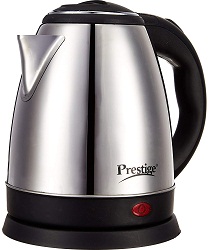
You’ll balance speed versus longevity: rapid high‑wattage models heat faster but may stress components. Prioritise validated accuracy and robust safety features to ensure controlled, reliable operation in Indian kitchens. Many trusted Indian brands like Prestige also offer models that emphasize safety and durability.
Top 10 Electric Kettles With Precise Temperature Control
Looking for kettles that give repeatable brewing temperatures? You’ll want models with PID or microcontroller regulation, stainless-steel or glass interiors, calibrated probes, and clear temperature presets. Compare performance: stability (±1–2°C), ramp time, and hold accuracy. Prioritize auto-shutoff, boil-dry protection, and cool-touch handles for safety. Select kettles offering incremental set points (e.g., 40–100°C in 1–5°C steps) if you brew varied teas or pour-over coffee.
Top performers combine fast heating with tight control—look for units with insulated bases, sealed temperature sensors, and reliable relays to avoid electrical arcing. Evaluate materials: food-grade 304/316 stainless steel reduces leaching; borosilicate glass lets you inspect heating. Check certification (BIS/ISI/CE) and warranty service. If you need timer or keep-warm functions, ensure they don’t override safety cutouts. Finally, read measured reviews that report sustained temperature curves rather than marketing claims—those give the clearest safety and performance picture. Consider kettles with precise boil times to ensure consistent results and efficient energy use.
Best Budget Options Under ₹3,000
If you want precise temperatures without spending a premium, there are reliable kettles under ₹3,000 that balance control and safety. You’ll get accurate presets, decent PID-style controllers or multi-step thermostats, and mandatory safety features like auto-shutoff and boil-dry protection. Expect stainless interiors or food-grade coatings, single-degree accuracy claims are rare but ±2–3°C repeatability is common.
- Budget model A — simple digital controller, 3 presets, quick heat-up, insulated handle; best for straightforward use.
- Budget model B — rotary selector with hold function, easier maintenance, reliable thermal cut-out; best for durability.
- Budget model C — LCD display, keep-warm for 30–60 minutes, concealed element; best balance of features and safety.
Compare cycle times, warranty, and service network. Verify IPX rating for the base and check that temperature readings are externally certified or backed by user tests. These choices prioritize consistent control and built-in protections rather than advanced fine-tuning. Regular descaling with white vinegar helps prevent mineral buildup and maintain heating efficiency.
While premium kettles cost more up front, they deliver tighter temperature control, faster recovery, and build-quality that justifies the price. You’ll get precise PID-like regulation, multi-stage presets, and metal housings with food-grade interiors that reduce leaching and improve sanitation. Safety features—auto-shutoff, boil-dry protection, insulated handles—are engineered rather than bolted on. Compare models by sensor type, warranty depth, and service network; higher-end units often include replaceable elements and certified components. You can also use an electric kettle for quick tasks like boiling water for instant noodles in a hurry.
| Feature | Emotional Benefit | Technical Signal |
|---|---|---|
| Precision ±0.5°C | Confidence | High-resolution thermostat |
| Stainless interior | Reassurance | 304/316L grade |
| Safety interlocks | Peace of mind | Redundant cutoffs |
| Warranty & service | Long-term trust | 2–5 year coverage |
Choose a premium kettle if you value consistent extraction for specialty teas, certified materials, and robust safety engineering that minimizes risk over years of use.
Energy Efficiency and Speed Comparison
How fast and efficiently a kettle heats water dictates both your waiting time and your electricity bill, so you’ll want to compare power ratings, element design, and insulation R-values rather than rely on advertised boil times alone. You should prioritise models with higher wattage for speed, but note that efficiency depends on how well the element couples heat to water and how much is lost to the shell.
- Compare wattage vs capacity: higher watts cut time proportionally, but diminishing returns occur above ~2200 W for typical 1–1.7 L kettles.
- Element design and placement: concealed stainless-steel flat elements transfer heat quickly and are easier to descale than exposed coils, reducing performance loss over time.
- Insulation and lid seal R-values: better insulation reduces reheating cycles; tight lids limit convective losses during rapid heat-up.
Use these metrics to select a temperature-control kettle that balances quick heat-up with sustained efficiency; avoid choices that sacrifice long-term performance for short-term speed. Regular descaling with vinegar or lemon helps maintain element efficiency and prolong kettle lifespan.
Safety Features and Build Quality to Consider
Speed and efficiency matter, but you also need to check how a kettle protects you and holds up over time. You’ll want auto shut-off and boil-dry protection as baseline: they cut power when boiling finishes or when no water’s present, preventing overheating. Compare kettles with dual sensors versus single-sensor designs — dual sensors give faster, more reliable cut-offs. Look for cool-touch exteriors and insulated handles to reduce burn risk; metal-bodied units should have clear thermal breaks. A locking lid and secure spout reduce spill hazards during pouring. For durability, prioritize 304 stainless steel or BPA-free thick polymer; thin plastics deform faster and can leach when stressed. Check hinge construction and cord strain relief: reinforced hinges and removable, swiveling bases last longer under repeated use. Also evaluate IP or splash-resistance ratings if you’ll use the kettle near sinks. Finally, choose models with clear safety certifications (BIS, CE) and accessible warranty terms — that’s your objective measure of build quality and consumer protection. For kettles you plan to use for dairy, consider models with temperature control to prevent scorching and make cleaning easier.
Maintenance, Cleaning, and Longevity Tips
You should establish a regular descaling routine based on your water hardness—monthly for hard water, quarterly for soft—to protect heating efficiency and temperature accuracy. Wipe the exterior with a damp cloth and mild detergent, and avoid abrasive cleaners that can damage finishes or insulation. Clean or replace mesh filters regularly to maintain flow rate and prevent scale transfer into cups. Also, inspect cords and bases regularly to ensure safe operation and prevent electrical hazards.
Regular Descaling Routine
Because mineral buildup directly reduces heating efficiency and can damage elements, you should establish a regular descaling routine for any temperature-controlled electric kettle. You’ll protect sensors and maintain accurate temperature control by removing limescale before it accumulates. Use food-safe descalers (citric acid or white vinegar diluted) and avoid abrasive tools that can scratch inner surfaces.
- Rinse: fill halfway, heat to near-boil, let sit 15–20 minutes, then discard and rinse thoroughly.
- Treat: add descaling solution per product instructions or 1–2 tablespoons citric acid in water, heat, cool, soak 20–30 minutes to dissolve deposits.
- Verify: flush with two full kettlefuls of fresh water, then test temperature accuracy at common set points.
Perform monthly for hard water, quarterly for soft; always follow manufacturer safety guidelines.
Exterior and Filter Care
The exterior finish and removable filter affect both hygiene and long-term performance, so you’ll want a quick, regular care routine that’s gentle yet effective. Wipe the outer housing with a damp microfiber cloth; avoid abrasive pads and solvent cleaners that’ll strip coatings or damage plastic. For stainless steel models use a mild detergent solution, then dry immediately to prevent watermarks and corrosion. Inspect the filter (mesh or anti-scale disc) weekly; rinse under running water and brush with a soft toothbrush to remove particulates. Replace disposable filters per manufacturer intervals or if deformation occurs. Never immerse the base or exposed electrical connections; unplug before cleaning. Compare models by filter accessibility and exterior material — easier access and stainless or high-grade plastic yield safer, longer-lasting performance with minimal maintenance.
How to Choose the Right Capacity and Design
How many cups do you actually need at once, and how will the kettle fit your countertop and storage? Choose capacity and design by matching volume, footprint, and safety features to your routine. Smaller (0.6–1.0 L) models heat faster and waste less energy; larger (1.5–1.7 L) serve groups but need more space and longer boil times. Prioritise stable bases, cool-touch handles, and secure lids to minimise scald risk.
- Compare capacity to typical servings and heat-up time for energy efficiency.
- Assess footprint and cord storage so the kettle sits securely without clutter.
- Verify materials (stainless steel, BPA-free plastics), spout design for drip-free pouring, and temperature control accuracy for safety.
Select a compact, well-balanced model if you have limited counter area and solo use; opt for larger, heavier designs only if you regularly serve multiple people. Always confirm auto-shutoff and boil-dry protection are present and tested. For travel or small-space use, consider foldable or compact options like the InstaCuppa foldable silicone model to save space and weight.
Frequently Asked Questions
Do Temperature-Controlled Kettles Work at High Altitudes?
Yes — they work, but boiling points drop with altitude, so temperature readings stay accurate while true boiling occurs lower. You’ll need to adjust settings and safety margins; sensors remain reliable, but expect longer times and different boiling behavior.
Can I Use Hard Water Without Damaging the Thermostat?
You can, but hard water accelerates scale buildup which can insulate heating elements and impair thermostat sensors; you’ll reduce risk by using filtered or descaled water, periodic descaling, or a kettle with replaceable/scale-resistant elements and sensor protection.
Are Warranty Repairs Available Nationwide in India?
Yes — most manufacturers offer nationwide warranty repairs, but coverage varies by brand and model; you’ll need to check service center availability, registration requirements, and excluded faults to ensure safe, compliant repair and avoid voiding warranty.
Do These Kettles Support Voltage Stabilizers or Inverters?
Yes — most kettles run on AC mains and’ll work with stabilizers; few are designed for direct inverter output, so you’ll need a pure sine-wave inverter or check manufacturer specs to assure safe voltage/frequency compatibility and warranty.
Can I Replace the Heating Element Myself?
Generally no — you shouldn’t replace the heating element yourself unless you’re qualified. Most kettles have sealed or integrated elements; DIY risks voiding warranty, electrical shock, or fire. Prefer certified service or manufacturer replacement for safety.